 English
 Русский
 Bahasa Indonesia
 Bahasa Malay
 ไทย
ไทย Español
 Deutsch
 Български
 Français
 Tiếng Việt
 中文
中文 বাংলা
বাংলা हिन्दी
 Čeština
 Українська
 Română



Gold maintains its upward momentum. Renewed fears of a trade war, combined with escalating geopolitical tensions in the Middle East, have been the main catalysts supporting gold as a safe haven and have reinforced the favorable outlook.
U.S. President Donald Trump, following a ruling by the Supreme Court of the United States against his broad tariff measures, announced a new program and introduced a 15% tariff—the legal maximum—on imports into the United States. This has heightened concerns about retaliatory actions and economic risks arising from disruptions in global supply chains, undermining risk appetite and reviving interest in gold as a hedge.
Friday's data showed that the U.S. Personal Consumption Expenditures (PCE) index rose 2.9% year-over-year. The core measure, excluding food and energy, increased 3.0% year-over-year, reinforcing expectations that the Federal Reserve will leave interest rates unchanged at its upcoming March meeting. However, traders are still pricing in two 25-basis-point rate cuts over the course of the year.
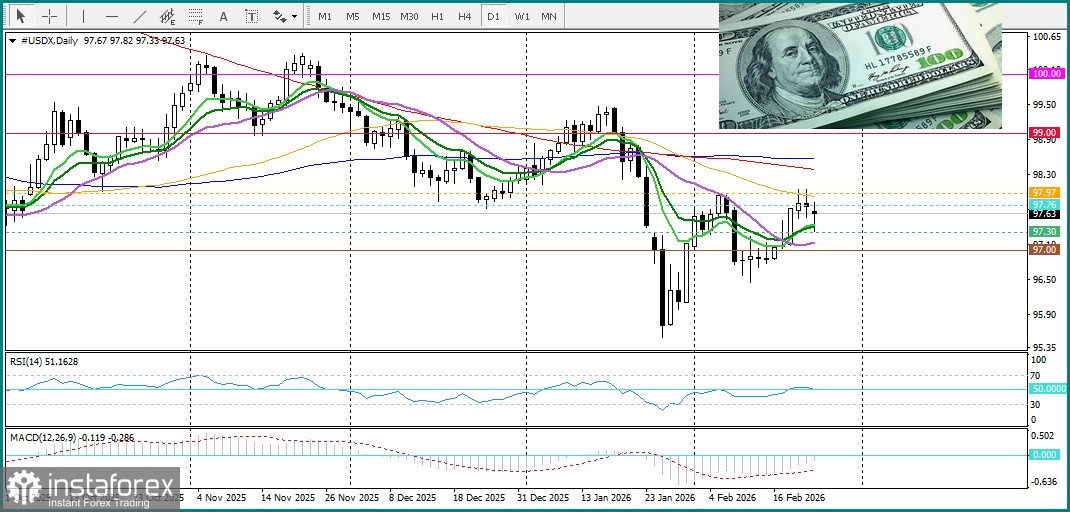
These expectations are supported by weak U.S. GDP data: in the fourth quarter, the economy grew only 1.4% year-over-year, compared to 4.4% in the third quarter, amid a record government shutdown. Together with trade uncertainty, this is putting pressure on the U.S. dollar and thereby supporting gold prices.
In addition, the risk of a military conflict between the United States and Iran is contributing to the rise in the precious metal. Talks between the U.S. and Iran are scheduled for Thursday. If diplomatic efforts fail to curb Tehran's nuclear ambitions, President Trump could take more extensive action and launch a military strike against Iran in the coming days.
From a technical perspective, gold has broken above the 5100 level, opening the way toward a new all-time high, with a potential pause around the 5400 level. Oscillators on the daily chart remain positive, suggesting that the path of least resistance for the yellow metal is to the upside.