 English
 Русский
 Bahasa Indonesia
 Bahasa Malay
 ไทย
ไทย Español
 Deutsch
 Български
 Français
 Tiếng Việt
 中文
中文 বাংলা
বাংলা हिन्दी
 Čeština
 Українська
 Română


For several weeks in a row, I want to start the "Weekly Dollar Preview" not with the phrase "everything will depend on US news." But unfortunately (or fortunately), there's no other way to put it. Over the weekend, two new-old wars have started in the world at once. Firstly, Donald Trump, with the help of Israel, has indeed initiated military intervention in Iran, which, after a day, appears to be a full-fledged war in the region, involving not only Israel, the US, and Iran. Iran's response is aimed at the total destruction of everything living, and US allies are also leveling Tehran and other towns to the ground. Overall, this time the conflict has escalated seriously and may drag on for weeks and months. Despite the death of Iran's supreme commander, Ali Khamenei, his closest aides and associates have taken over, so there is no talk of stopping hostilities, and the political course has not changed. Iran is fighting to the death and is prepared to sacrifice everything rather than abandon its nuclear weapons and development.
The only thing left to understand is how the market will react to the situation. On the one hand, in recent weeks, market participants have been actively preparing for a new war. On the other hand, no one could have imagined that missiles would fly in both directions and hit not only military targets.
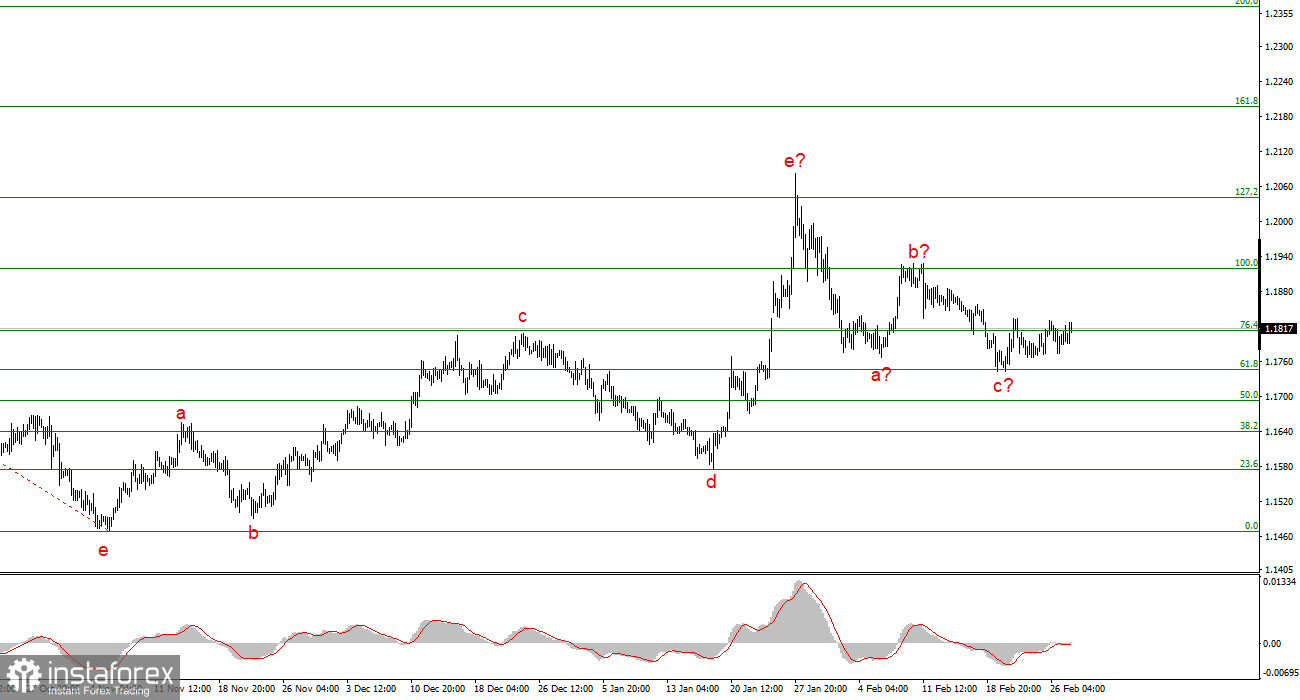
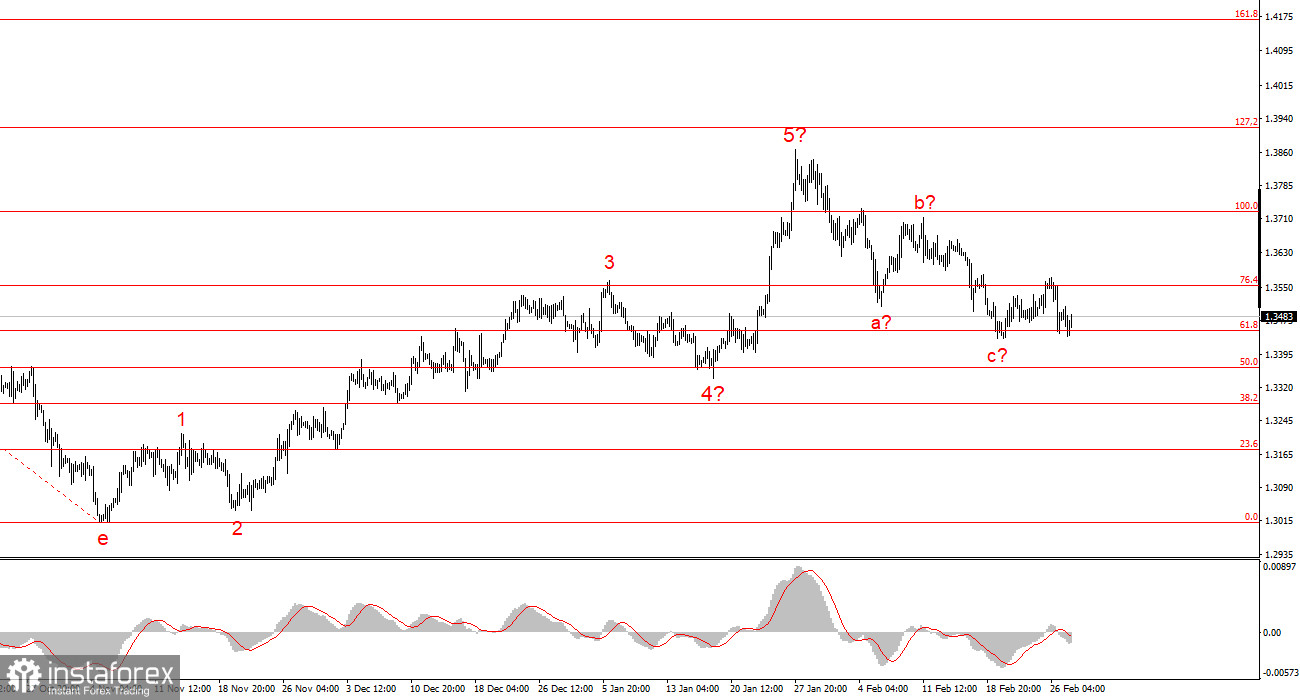
There will also be many economic events in America. The ISM indices of business activity in services and manufacturing, the Nonfarm Payrolls and ADP reports, unemployment rates, and retail sales. The first week of March promises to be hyperactive. However, predicting the movements of key instruments over the next five days will likely be difficult for anyone right now. American reports could push the dollar higher or lower. It's impossible to predict the market's reaction to the war in the Middle East. As a primary scenario, I propose still considering the construction of a new upward wave structure, based on the levels of 1.1746 for EUR/USD and 1.3451 for GBP/USD.
Wave Analysis of EUR/USD:
Based on the analysis of EUR/USD, I conclude that the instrument continues to build an upward trend segment. Trump's policies and the Fed's monetary policy remain significant factors in the long-term decline of the US currency. The targets for the current segment of the trend could stretch up to the 25th figure. At present, I think that the instrument remains within the framework of global wave 5, so I expect an increase in quotations in the first half of 2026. The corrective structure a-b-c could be completed at any moment, as it has already taken a convincing form. I believe it is now prudent to search for areas and levels for new purchases with targets around 1.2195 and 1.2367, which correspond to 161.8% and 200.0% on the Fibonacci.
Wave Analysis of GBP/USD:
The wave picture of the GBP/USD instrument presents a clear view. The five-wave upward structure has completed its formation, but the global wave 5 may take on a much more extensive form. I believe that the construction of a corrective set of waves may finish soon, after which the upward trend will resume. Therefore, I can now advise searching for opportunities for new purchases with targets set above the 39 figure. In my opinion, under Trump, the British pound has a good chance of rising to $1.45-$1.50.
Key Principles of My Analysis:
- Wave structures should be simple and comprehensible. Complex structures are difficult to trade and often carry changes.
- If there is no confidence in what is happening in the market, it is better not to enter it.
- There is never 100% certainty in the direction of movement. Do not forget about protective Stop Loss orders.
- Wave analysis can be combined with other types of analysis and trading strategies.