 English
 Русский
 Bahasa Indonesia
 Bahasa Malay
 ไทย
ไทย Español
 Deutsch
 Български
 Français
 Tiếng Việt
 中文
中文 বাংলা
বাংলা हिन्दी
 Čeština
 Українська
 Română


Trade Review and Advice on Trading the Japanese Yen
The test of the 157.08 level occurred when the MACD indicator had already moved significantly above the zero mark, which limited the pair's upward potential. For this reason, I did not buy the dollar.
In the second half of the day, the key market-moving event will be the U.S. ISM Manufacturing PMI report. The release of positive results for this indicator is expected to boost interest in the U.S. currency. If the ISM index exceeds forecast levels, an immediate reaction in the currency markets should be expected. Most likely, the U.S. dollar will strengthen against the Japanese yen. However, associated risks should not be ignored. The release of weak data—if the ISM index falls short of expectations or shows a decline—could produce the opposite effect. In such a scenario, the dollar would most likely weaken, although due to the escalation of the conflict in the Middle East, a large-scale sell-off in USD/JPY should not be expected. While Japan does not directly support the bombing of Iran, almost none of the world's leading countries have condemned the actions of the United States. Any major news regarding the development of the conflict will directly affect USD/JPY volatility.
As for the intraday strategy, I will mainly rely on implementing Scenarios No. 1 and No. 2.
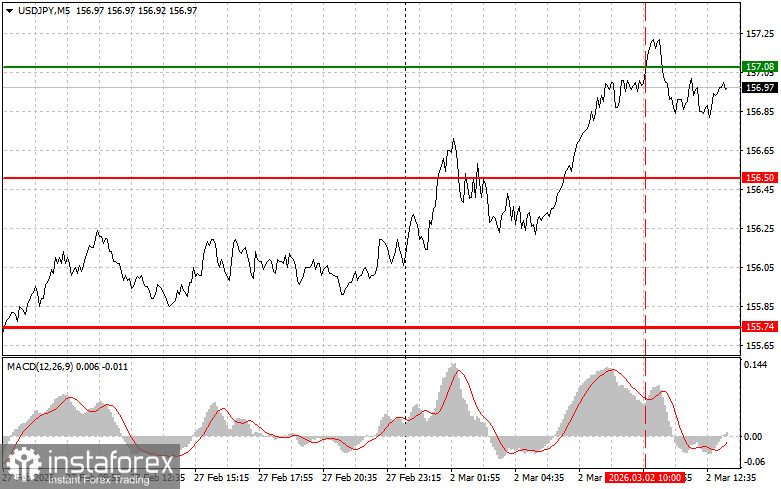
Buy Signal
Scenario No. 1: Today, I plan to buy USD/JPY upon reaching the entry point around 157.08 (green line on the chart), with a target of 157.55 (thicker green line on the chart). Around 157.55, I will exit long positions and open short positions in the opposite direction (aiming for a 30–35 point move in the opposite direction from that level). Growth in the pair today can be expected after strong economic data.Important! Before buying, make sure that the MACD indicator is above the zero mark and just beginning to rise from it.
Scenario No. 2: I also plan to buy USD/JPY today if there are two consecutive tests of the 156.80 level while the MACD indicator is in the oversold area. This will limit the pair's downward potential and trigger an upward market reversal. Growth toward the opposite levels of 157.08 and 157.55 can be expected.
Sell Signal
Scenario No. 1: Today, I plan to sell USD/JPY after it breaks and updates the 156.80 level (red line on the chart), which should lead to a rapid decline in the pair. The key target for sellers will be 156.31, where I will exit short positions and immediately open long positions in the opposite direction (aiming for a 20–25 point move in the opposite direction from that level). Pressure on the pair will return in the event of weak reports.Important! Before selling, make sure that the MACD indicator is below the zero mark and just beginning to decline from it.
Scenario No. 2: I also plan to sell USD/JPY today if there are two consecutive tests of the 157.08 level while the MACD indicator is in the overbought area. This will limit the pair's upward potential and trigger a downward reversal. A decline toward the opposite levels of 156.80 and 156.31 can be expected.
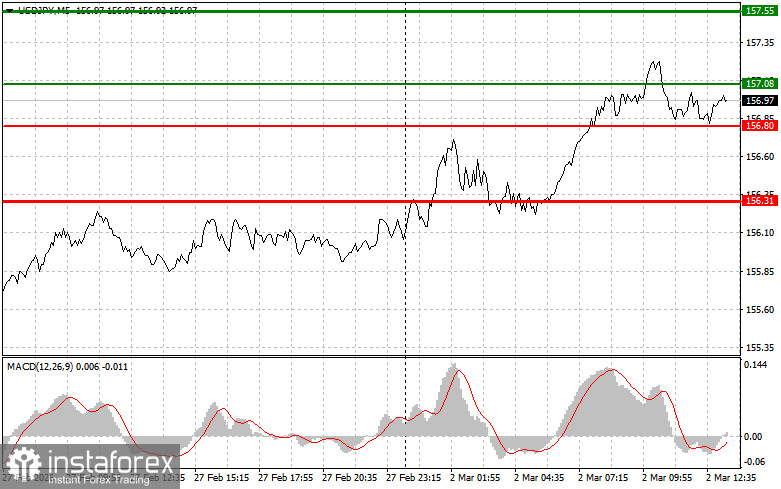
What's on the Chart:
- Thin green line – entry price at which you can buy the trading instrument.
- Thick green line – estimated level where you can set Take Profit or manually lock in profits, as further growth above this level is unlikely.
- Thin red line – entry price at which you can sell the trading instrument.
- Thick red line – estimated level where you can set Take Profit or manually lock in profits, as further decline below this level is unlikely.
- MACD indicator – when entering the market, it is important to rely on overbought and oversold zones.
Important. Beginner Forex traders should be very cautious when making market entry decisions. Before the release of important fundamental reports, it is best to stay out of the market to avoid sharp exchange rate fluctuations. If you decide to trade during news releases, always place stop-loss orders to minimize losses. Without stop-loss orders, you can very quickly lose your entire deposit, especially if you do not apply proper money management and trade large volumes.
And remember, successful trading requires a clear trading plan, like the one presented above. Spontaneous trading decisions based on the current market situation are inherently a losing strategy for an intraday trader.