 English
 Русский
 Bahasa Indonesia
 Bahasa Malay
 ไทย
ไทย Español
 Deutsch
 Български
 Français
 Tiếng Việt
 中文
中文 বাংলা
বাংলা हिन्दी
 Čeština
 Українська
 Română


The GBP/USD pair continues to decline within a broader bullish trend. The only valid pattern at the moment remains bearish imbalance 16, but bulls were short by just 6–7 points from touching it last week and forming a signal. As a result, traders had no reason to open short positions, even though the pound has since fallen by 250 points. It is also important to remember that the bullish trend remains intact. The pair could fall even to the 1.3100 level, and the bullish trend would still remain relevant. Even amid a serious war in the Middle East, I question the rationale for selling. The current move appears overly emotional and panic-driven, and such moves usually do not last long.
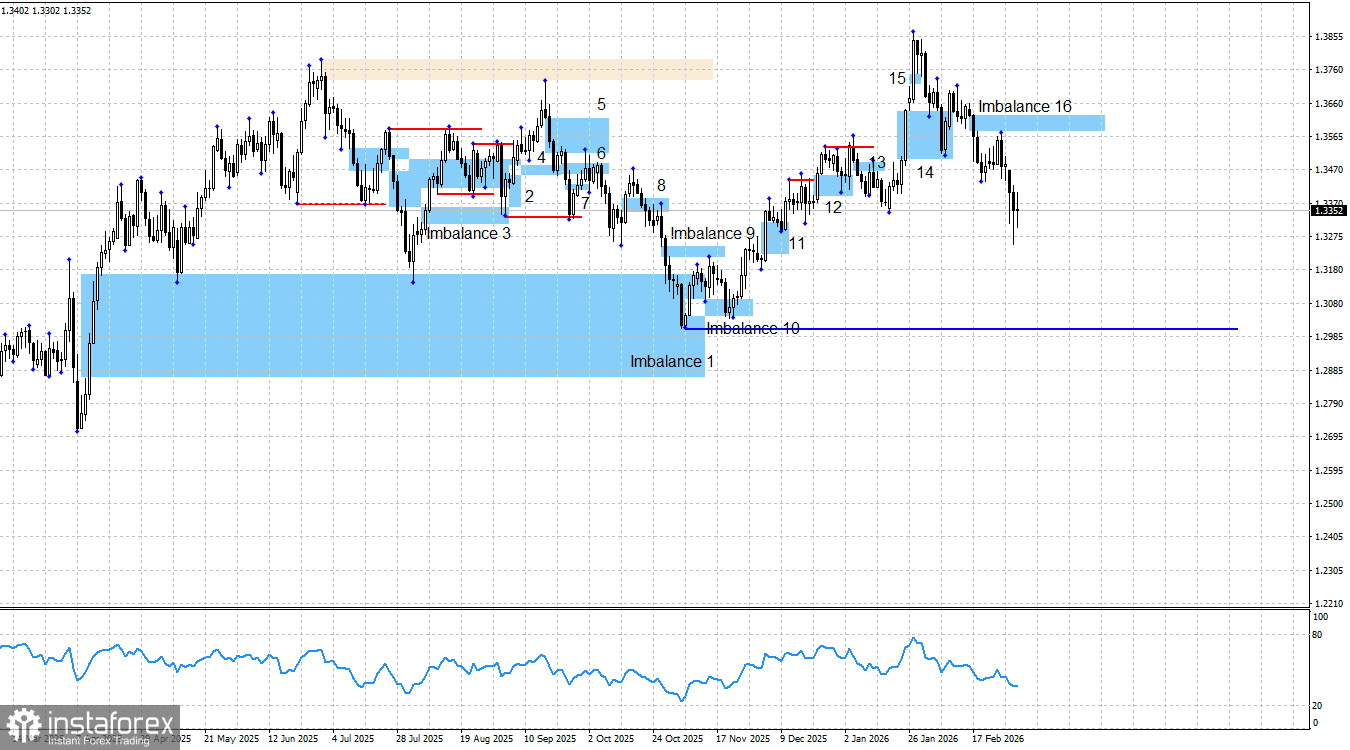
With sufficient effort, several liquidity grabs from bearish swings can now be identified on the daily chart. However, I prefer to work with clear and obvious swings, and I remind you that a liquidity grab is not a pattern or a signal. At present, there are no bullish patterns, and it is unlikely that the price will soon return to imbalance 16 and provide a signal on a second attempt. In my view, if there is no new escalation in the Middle East in the coming days, the pound may begin to recover gradually. On Friday, bulls will likely hope for weak U.S. labor market and unemployment data. Thus, no matter how disappointing this week has been for the pound, it could still end on a decent note.
The bullish trend in the pound remains intact. Therefore, as long as it holds (above 1.3012), I would focus more on bullish signals. The pound's decline may be significant, but it could also end at any moment. The only currently relevant imbalance 16 has not generated any signal. No new bearish patterns are expected this week either. Consequently, market attention may shift to U.S. economic reports and technical analysis.
On Wednesday, the news background once again carried little significance for traders. The February ADP report showed a stronger reading than expected, but traders remember last month's data, when ADP was close to zero while Nonfarm Payrolls reported 130,000 new jobs. Confidence in ADP remains limited.
In the United States, the broader news background continues to suggest that, in the long term, little can be expected other than dollar weakness. The conflict between Iran and the U.S. has changed little in this regard. The situation for the U.S. dollar remains challenging in the long term and relatively positive in the short term — but only in the short term. U.S. labor market statistics have disappointed more often than they have impressed. Three of the last four FOMC meetings ended with dovish decisions. Trump's military actions, threats toward Denmark, Mexico, Cuba, Colombia, EU countries, Canada, and South Korea, legal proceedings against Jerome Powell, government shutdowns, the scandal involving U.S. elites in the Epstein case, the possibility of Trump's impeachment by year-end, and the high likelihood of Republican electoral losses all reinforce the picture of political and structural crisis in America. In my view, bulls have sufficient grounds to continue their advance throughout 2026.
A bearish trend would require a strong and stable positive news background for the dollar, which is difficult to expect under Donald Trump. Therefore, I still do not believe in a sustained bearish trend for the pound. Too many risk factors continue to weigh heavily on the dollar. Bearish patterns may offer opportunities for short positions, but personally I would not recommend this to traders. I consider the recent decline in the pair to be, to some extent, the result of an unfortunate combination of circumstances.
News Calendar for the United States and the United Kingdom:
- United States – Initial Jobless Claims (13:30 UTC)
On March 5, the economic calendar contains only one secondary event. The news background may have little impact on market sentiment on Thursday, which could allow bulls to slightly improve their position.
GBP/USD Forecast and Trading Advice:
For the pound, the overall picture remains bullish, although the short-term outlook has turned bearish. There are currently no active bullish patterns. Only bearish imbalance 16 remains, and the price would first need to return to it and generate a reaction before traders could consider potential short positions.
It should be noted that the pound's decline over the past few weeks has been strong enough to distort the bullish picture due to an unfortunate set of circumstances. If Donald Trump had not repeatedly threatened to attack Iran, sent warships to the Persian Gulf, and ultimately initiated military action, we likely would not have seen such a sharp drop. I believe this decline could end as unexpectedly as it began. In my view, the broader trend has not turned bearish in recent weeks.