 English
 Русский
 Bahasa Indonesia
 Bahasa Malay
 ไทย
ไทย Español
 Deutsch
 Български
 Français
 Tiếng Việt
 中文
中文 বাংলা
বাংলা हिन्दी
 Čeština
 Українська
 Română


As I mentioned in previous reviews, the Bank of England could be the only one of the "big three" to raise interest rates in 2026. A unanimous decision was made to keep the interest rate at 3.75%, with all nine members of the MPC voting in favor. However, this decision may leave the underlying context somewhat unclear.
At the last meeting in early February, the Bank of England was very close to conducting a round of monetary easing. Andrew Bailey's vote was decisive, and the hawks won by a narrow 5-4 margin. Markets were expecting at most two of nine votes in favor of easing six weeks ago, but in fact there were twice as many, which set a dovish tone ahead of the current meeting. Undoubtedly, when the war in the Middle East ceased to be a looming threat and became an objective reality, those dovish sentiments evaporated among traders. Yet, even today, the market anticipated two votes in favor of easing, which turned out to be another miscalculation.
The BoE expects inflation to rise to 3.5% as early as March and to stabilize at this level in the third quarter. The future dynamics will depend on developments in the Middle East conflict and the world's ability to resolve oil and gas-related issues. In its accompanying statement, the BoE emphasized its commitment to achieving its 2% inflation target. All members of the MPC agreed that the next month and a half would provide answers to pressing questions, particularly how long the conflict in the Middle East will last and how extensive it will be. If the conflict proves short-lived, monetary policy easing could resume, as the impact on inflation would be temporary. If, however, the conflict drags on, the BoE will be prepared to raise interest rates if necessary.
Based on the above, the BoE is a likely candidate for tightening. Will this help the British pound? In my view, not significantly, although it does gain some advantage over the dollar. Unfortunately, the market is currently influenced by geopolitics, and only geopolitical factors will determine the further dynamics of GBP/USD. News from the Persian Gulf remains discouraging, so I do not currently see strong reasons for a decline in the dollar. Only wave patterns indicate that a corrective structure is needed.
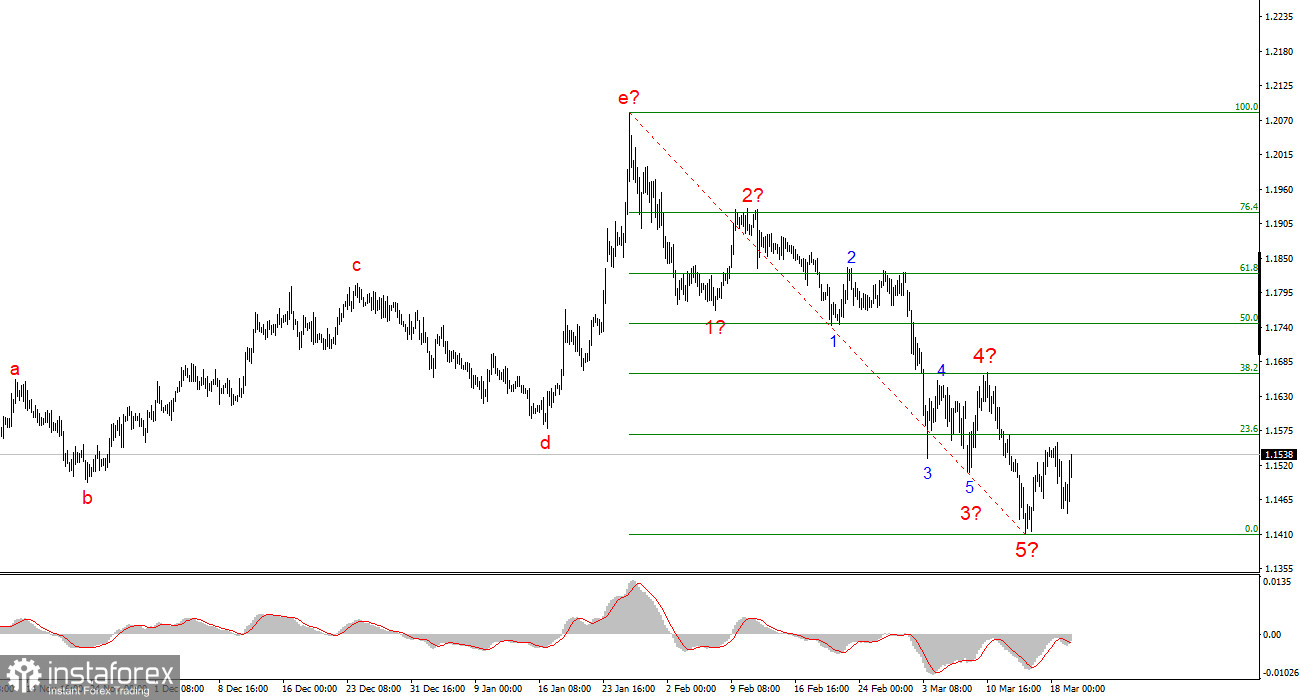
Wave Pattern for EUR/USD:
Based on the conducted analysis of EUR/USD, I conclude that the instrument remains within an upward segment of the trend (as shown in the lower image), but in the short term has begun constructing a downward segment. Since the five-wave impulsive structure has completed, my readers can expect price increases over the next week or two, with targets around 1.1568 and 1.1666, corresponding to the 23.6% and 38.2% Fibonacci. Further movements of the instrument will primarily depend on events in the Middle East.
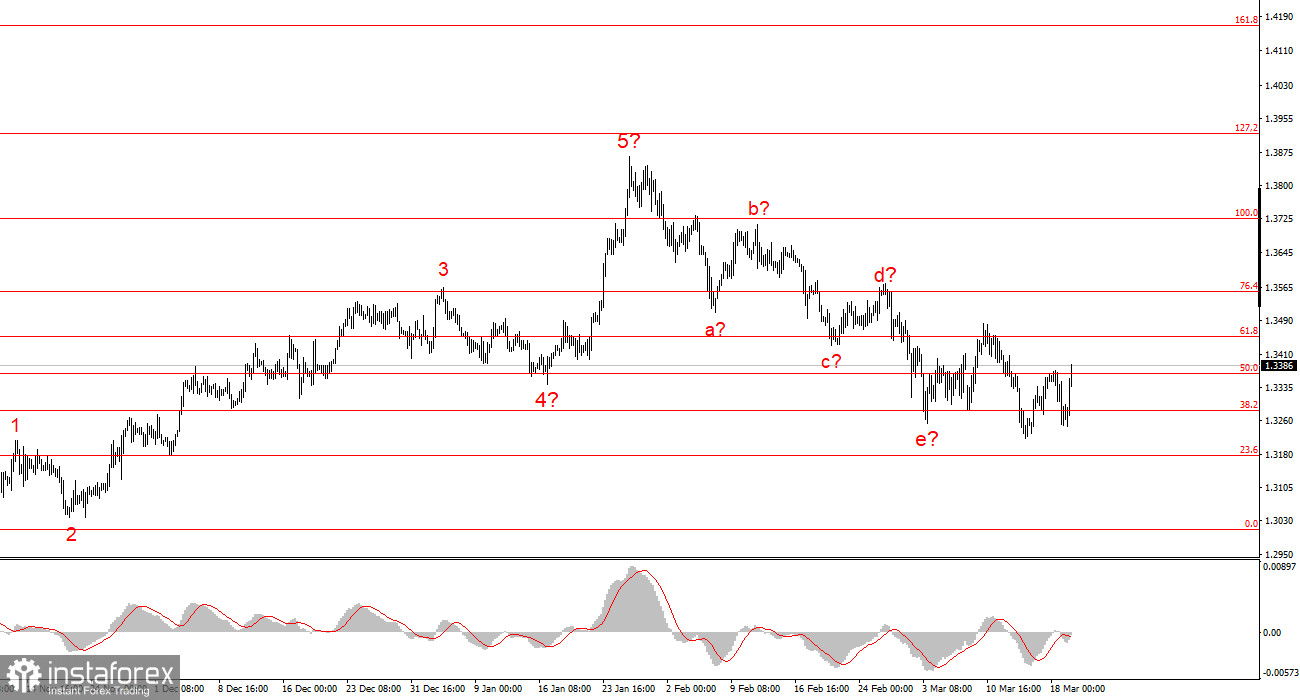
Wave Pattern for GBP/USD:
The wave pattern for the GBP/USD instrument has become very complex and difficult to read. We now see a seven-wave downward structure on the charts, which it certainly is not. Most likely, there is an extension or complication within one of the waves. However, this does not clarify the wave analysis. If the wave pattern has once been complicated to an unreadable form, it could complicate again several more times. Therefore, I believe we should focus on the wave analysis of the EUR/USD instrument, which appears much clearer. It is also crucial not to overlook the geopolitical factor, which could send both instruments into a new decline at any moment. If this does not occur, the euro and pound may anticipate growth within the framework of a correction.
Key Principles of My Analysis:
- Wave structures should be simple and understandable. Complex structures are difficult to trade and often lead to changes.
- If there is no certainty in the market, it's best not to enter it.
- There can never be 100% confidence in the direction of movement. Do not forget about protective Stop Loss orders.
- Wave analysis can be combined with other types of analysis and trading strategies.