 English
 Русский
 Bahasa Indonesia
 Bahasa Malay
 ไทย
ไทย Español
 Deutsch
 Български
 Français
 Tiếng Việt
 中文
中文 বাংলা
বাংলা हिन्दी
 Čeština
 Українська
 Română


Yesterday, equity indices closed mixed. The S&P 500 fell by 0.39%, while the Nasdaq 100 declined by 0.73%. The Dow Jones Industrial Average rose by 0.11%.
Market sentiment shifted notably in the morning: futures on equity indices climbed in early trading, while oil prices fell. That change in dynamics was a direct reaction to statements by US President Donald Trump addressed to his aides. In those remarks, he expressed the US willingness to end the military campaign against Iran despite significant constraints on navigation through the Strait of Hormuz.
That statement was clearly read by market participants as a signal of reduced geopolitical tension. Concerns about a possible escalation in the Middle East and potential disruption to oil shipments via the Strait of Hormuz are a key driver of energy pricing. Falling oil prices reflect a reduction in the risk premium priced into current quotes, thanks to the prospect of de-escalation.
At the same time, equity markets generally respond positively to lower geopolitical uncertainty. Improved investor sentiment and reduced fears about global economic stability boost risk appetite, which in turn lifts futures on major indices. S&P 500 futures rose by 0.8%, and European equity futures gained 0.3%. However, the Asian rebound was muted: the MSCI Asia Pacific index fell by 1% and appears set to post its worst month since October 2008.
West Texas Intermediate oil was essentially flat at about $103 per barrel. Earlier, the commodity approached nearly $107 per barrel. Treasuries continued to rally, and the dollar weakened against most G10 currencies.
A US withdrawal from the Iran conflict would help ease tensions and improve prospects for reopening the Strait of Hormuz, the key transit artery whose disruption has pushed oil prices higher. Restoring flows from the Middle East would benefit major Asian importers such as India and China and help dispel growth-risk concerns.
It is worth noting, however, that over the past month, Trump has publicly expressed varying positions on how to handle the closure of the waterway, part of a broader pattern of mixed objectives and messages on the war overall. At times, he threatened to bomb civilian energy infrastructure if the channel was not reopened by a set date. At others, he downplayed the strait's importance to the United States, saying its closure was a problem for other countries to solve.
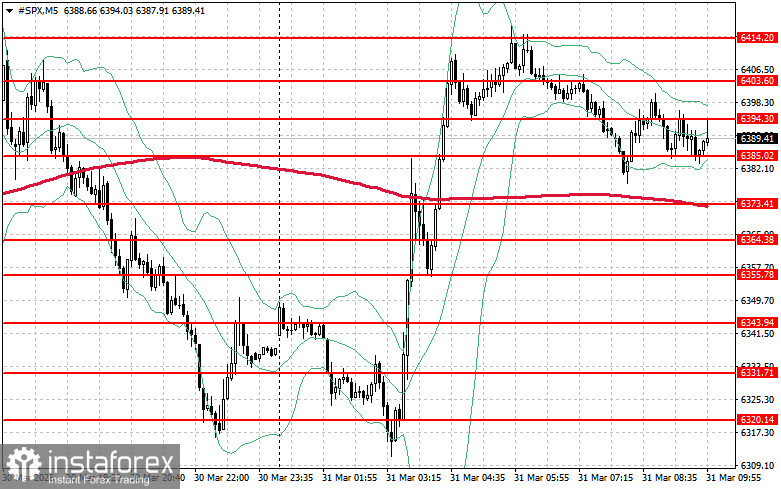
As for the S&P 500 technical picture, the main task for buyers today will be to overcome the nearest resistance level of $6,385. This would help the index gain upside momentum and could pave the way for a thrust to $6,394. Equally a priority for bulls will be control above $6,403, which would strengthen buyers' positions. In the event of a downside move amid reduced risk appetite, buyers must assert themselves around $6,373. A break below that level would quickly push the trading instrument back to $6,364 and open the way to $6,355.