 English
 Русский
 Bahasa Indonesia
 Bahasa Malay
 ไทย
ไทย Español
 Deutsch
 Български
 Français
 Tiếng Việt
 中文
中文 বাংলা
বাংলা हिन्दी
 Čeština
 Українська
 Română


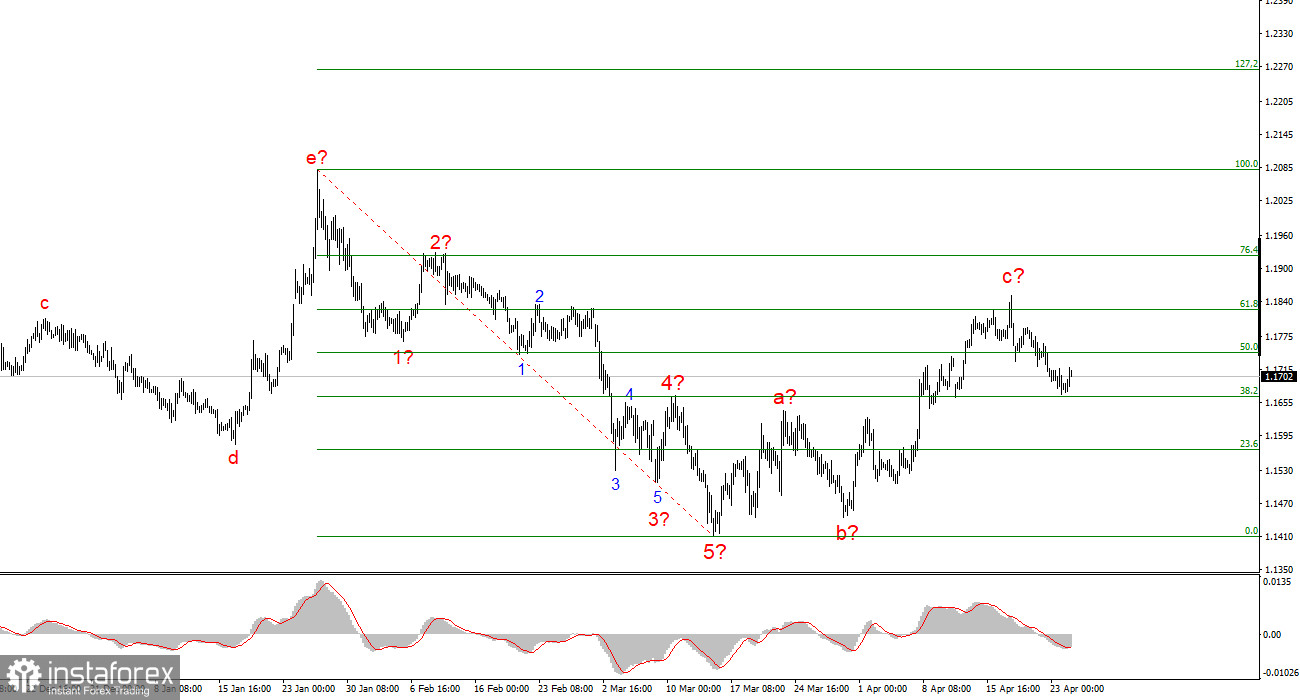
The wave pattern on the 4-hour chart for EUR/USD has changed. There is still no talk of canceling the upward trend segment (lower chart), which began in January of last year, but the wave structure now looks rather ambiguous. In such situations, I always recommend switching to a lower timeframe (upper chart) and focusing on the simplest and smallest wave structures to make a short-term forecast, which is sufficient for opening trades. Wave structures can be very complex and allow for multiple scenarios. The easiest approach is to trade standard "five-three" patterns.
In the chart above, a classic five-wave impulsive structure with an extended third wave can be identified. If this is indeed the case, then this structure has been completed, and a corrective formation of at least three waves is currently underway. We have already seen three waves, so the market is likely to form at least one more corrective wave in the near future. Future developments will depend on geopolitics: either the correction becomes more complex, or a new downward trend segment begins.
On Friday, EUR/USD rose by about 30 basis points, but that was the full extent of the day's movement. Volatility remained minimal, and the market still shows little willingness to trade amid complete geopolitical uncertainty. Throughout the week, the focus has been on the Strait of Hormuz, negotiations, and the likelihood of a deal—not because there is nothing else to discuss. For instance, the UK released important unemployment and inflation data this week, PMI figures for April were published (some of which were surprising), and Christine Lagarde spoke twice. However, all of this has little impact while the market remains focused solely on geopolitics.
Today it was reported that Iran's Foreign Minister is heading to Islamabad. For what purpose? Most likely for negotiations. At present, there is no confirmation that a U.S. delegation led by J.D. Vance is also heading to Pakistan's capital. However, it is reasonable to assume that negotiations are the main reason for such a visit. That said, it is too early to be optimistic. A second round of talks may take place over the weekend, but the outcome remains highly uncertain, and the chances of a lasting agreement are low. Washington and Tehran continue to exchange demands and ultimatums, creating the appearance of willingness to reach peace while showing no real intention to compromise. Therefore, it is quite possible that the next round of negotiations will also fail.
Conclusions
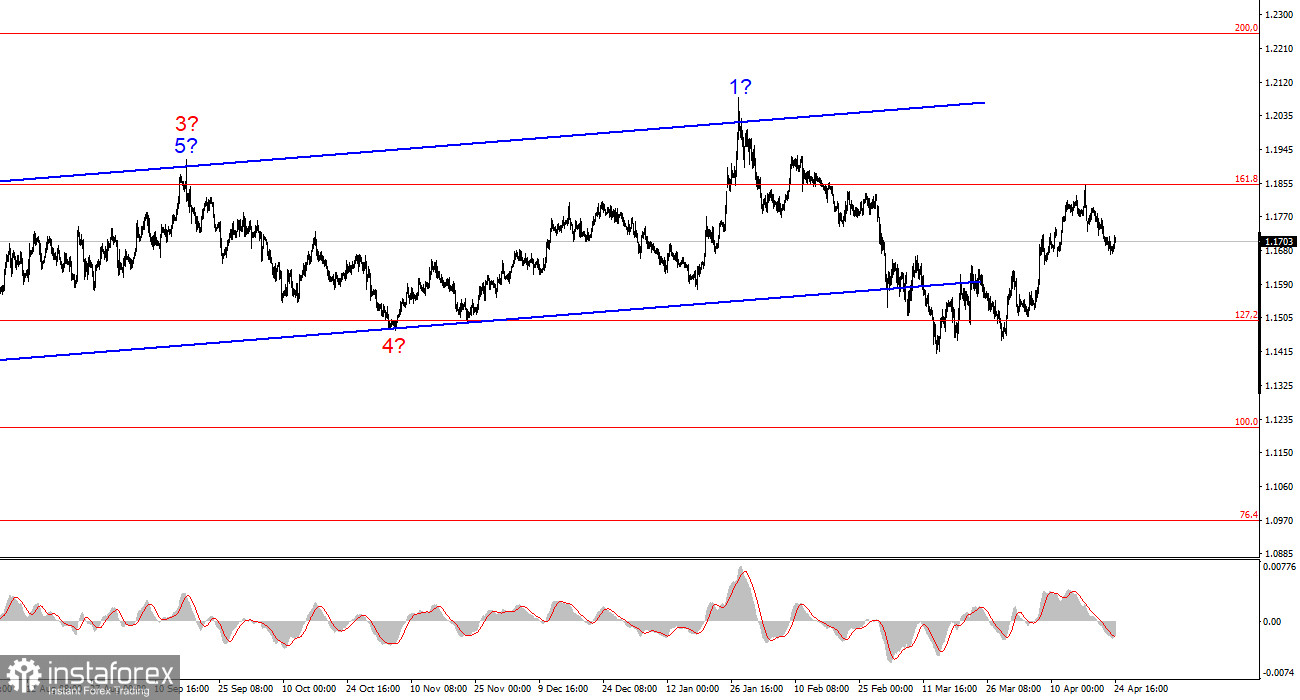
Based on this EUR/USD analysis, the pair remains within an upward trend segment (lower chart), while in the short term it is in a corrective phase. The corrective wave structure appears largely complete and could only become more complex and extended if the geopolitical situation in the Middle East improves. Otherwise, a new downward wave sequence may begin from current levels. A corrective wave has already formed, and further movement will depend on the outcome of the second round of negotiations between Iran and the United States.
On the lower timeframe, the entire upward trend segment is visible. The wave structure is not entirely typical, as corrective waves vary in size—for example, the larger wave 2 is smaller than the internal wave 2 within wave 3. However, such variations do occur. It is important to focus on clear and understandable structures rather than rigidly labeling every wave. In the near term, the trend may reverse.
Key Principles of My Analysis:
- Wave structures should be simple and clear. Complex structures are difficult to trade and often subject to change.
- If there is no confidence in market conditions, it is better to stay out.
- Absolute certainty about market direction is impossible. Always use protective Stop Loss orders.
- Wave analysis can be combined with other analytical methods and trading strategies.