 English
 Русский
 Bahasa Indonesia
 Bahasa Malay
 ไทย
ไทย Español
 Deutsch
 Български
 Français
 Tiếng Việt
 中文
中文 বাংলা
বাংলা हिन्दी
 Čeština
 Українська
 Română


Trade Review and Trading Tips for the Japanese Yen
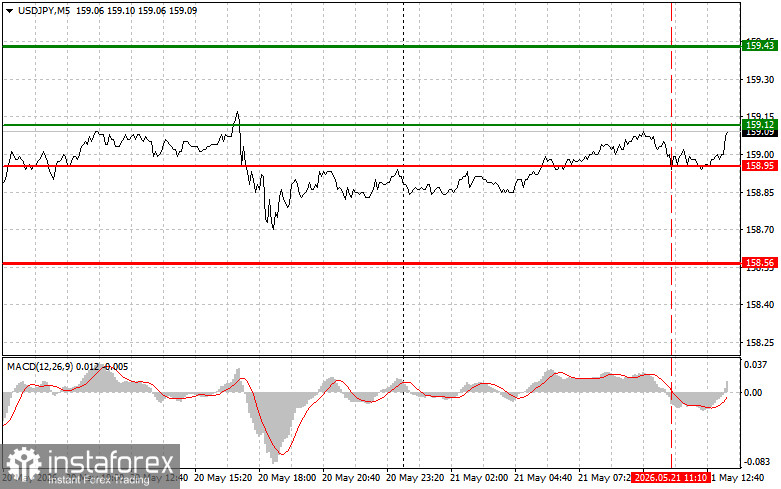
The price test at 158.95 occurred at a moment when the MACD indicator was just beginning to move downward from the zero line, which confirmed a valid entry point for selling the dollar. However, no downward movement in the pair followed.
In the second half of the day, investors will focus on the release of important US macroeconomic indicators that could significantly influence the dynamics of the US currency. First in line are weekly initial jobless claims data. Traditionally, a decline in this indicator signals an improving labor market and, consequently, favorable economic trends. Positive data could support further strengthening of the US dollar against the yen. Following the unemployment figures, building permits data will be released. This indicator is an important leading signal reflecting activity in the real estate development sector, which in turn has a significant impact on related industries and employment levels. An increase in permits will be seen as a sign of recovery or active growth in the construction sector, which would be somewhat surprising given the sharp rise in mortgage rates. Weak data, however, may put pressure on the dollar.
Equally important will be reports on key indices that provide insight into the manufacturing and services sectors. The US Manufacturing PMI and Services PMI are key barometers tracking trends in demand, production, employment, and price changes. Improvements in both indicators that exceed analyst expectations will be clearly interpreted as a signal of strong economic activity and a reason to buy the US dollar against the Japanese yen, among other currencies.
Regarding the intraday strategy, I will mainly rely on scenarios #1 and #2.
Buy Signal
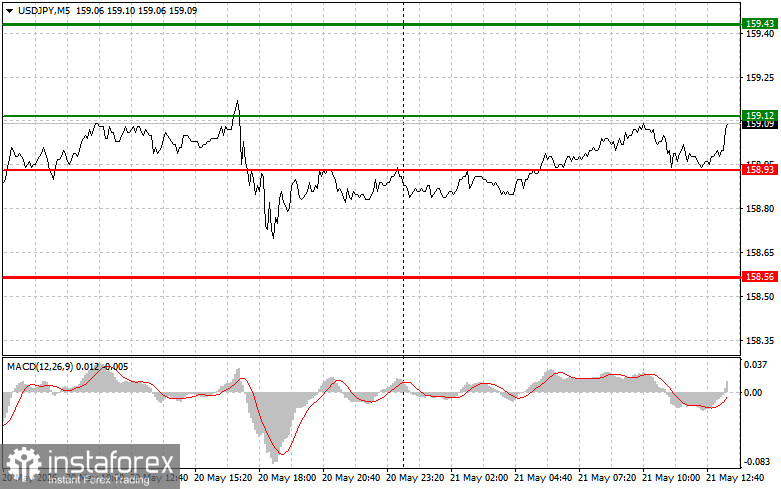
Scenario #1: I plan to buy USD/JPY today at an entry point around 159.12 (green line on the chart), targeting a rise to 159.43 (thicker green line). At 159.43, I will exit long positions and open short positions in the opposite direction, expecting a 30–35 point reversal. A rise in the pair today is possible on strong US data. Important: before buying, ensure that the MACD is above the zero line and just beginning to rise from it.
Scenario #2: I will also consider buying USD/JPY if there are two consecutive tests of 158.93 while the MACD is in oversold territory. This would limit downward potential and trigger an upward reversal. A move toward 159.12 and 159.43 can be expected.
Sell Signal
Scenario #1: I plan to sell USD/JPY after a break below 158.93 (red line on the chart), which would lead to a rapid decline in the pair. The key target for sellers is 158.56, where I will exit shorts and immediately consider buying in the opposite direction (expecting a 20–25 point rebound). Selling pressure may return on weak US data. Important: before selling, ensure that the MACD is below the zero line and just beginning to decline from it.
Scenario #2: I will also consider selling USD/JPY if there are two consecutive tests of 159.12 while the MACD is in overbought territory. This would limit upward potential and lead to a downward reversal. A decline toward 158.93 and 158.56 can be expected.
What is shown on the chart:
- Thin green line – entry price for buying the trading instrument
- Thick green line – target price (Take Profit level), where further growth is unlikely
- Thin red line – entry price for selling the trading instrument
- Thick red line – target price (Take Profit level), where further decline is unlikely
- MACD indicator – entry decisions should consider overbought and oversold conditions
Important Notice
Beginner Forex traders should be very cautious when entering the market. Before major fundamental releases, it is best to stay out of the market to avoid sharp price volatility. If you choose to trade during news releases, always set stop-loss orders to minimize losses. Without stop-loss orders, you may quickly lose your entire deposit, especially if you do not apply proper money management and trade large volumes.
Remember that successful trading requires a clear trading plan, similar to the one presented above. Making impulsive trading decisions based on current market conditions is, from the outset, a losing intraday trading strategy.