 English
 Русский
 Bahasa Indonesia
 Bahasa Malay
 ไทย
ไทย Español
 Deutsch
 Български
 Français
 Tiếng Việt
 中文
中文 বাংলা
বাংলা हिन्दी
 Čeština
 Українська
 Română


EUR/USD continued its decline on Wednesday after consolidating below the 50.0% Fibonacci retracement level at 1.1630, moving toward the next Fibonacci level of 61.8% at 1.1578. The bullish trend has only recently begun to emerge, but it could be invalidated at any moment. The U.S. dollar is strengthening once again, as daily developments in the Middle East continue to contradict Donald Trump's promises of a swift peace agreement and the reopening of the Strait of Hormuz. A close above the 1.1630 level would favor the euro and signal a resumption of the upward move toward the 38.2% retracement level at 1.1682.
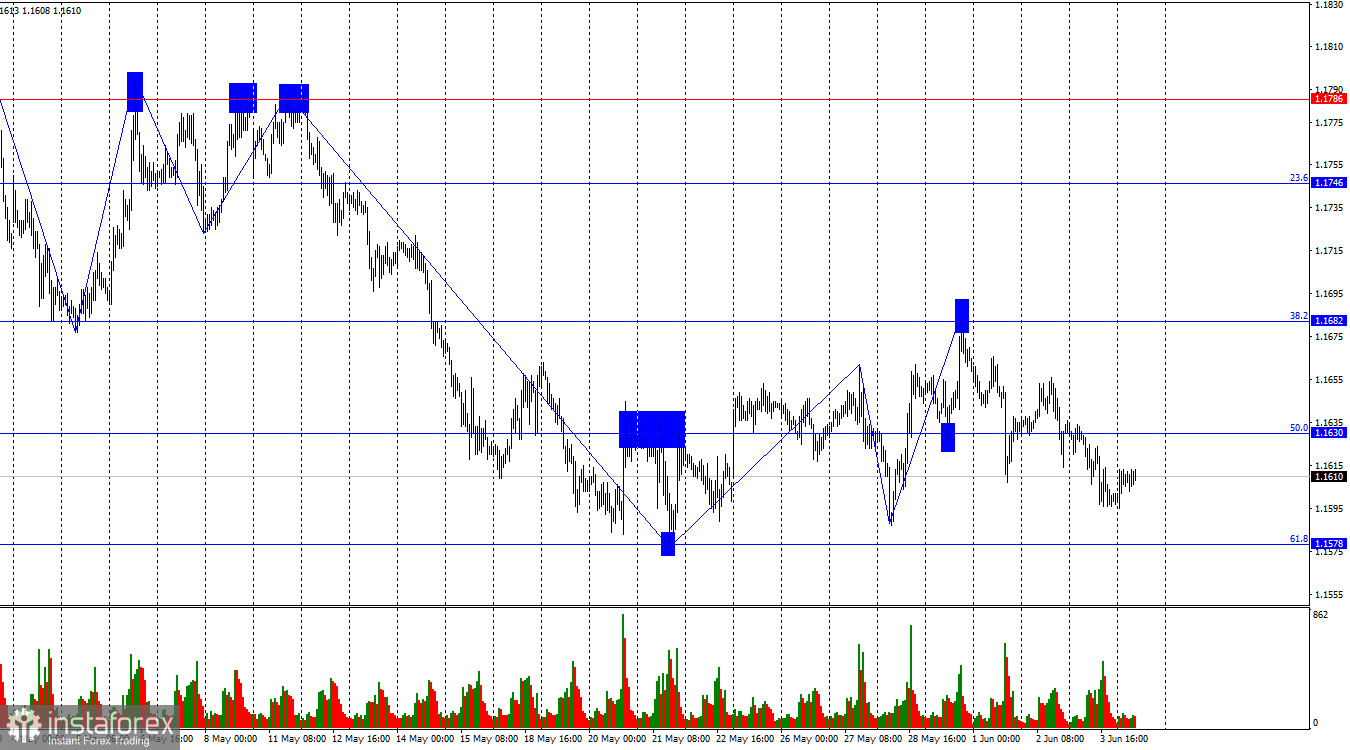
The wave structure on the hourly chart remains relatively straightforward. The latest completed upward wave broke above the previous high, while the most recent downward wave failed to break the previous low. As a result, the trend has shifted to bullish. However, bulls will only be able to extend their advance if Iran and the United States reach an interim agreement, stop violating the ceasefire terms, and reopen the Strait of Hormuz in the near future. Without these developments, a sustained rally will be extremely difficult to achieve.
Wednesday's U.S. economic data provided additional support for the bears. The ISM Services PMI rose to 54.5 points in May, exceeding market expectations of 53.8. Earlier, the ISM Manufacturing PMI also came in above forecasts. In addition, the ADP employment report released yesterday deserves attention, despite often being overshadowed by the Nonfarm Payrolls report. According to ADP data, total employment increased by 122,000 in May, surpassing analysts' expectations.
Therefore, yesterday's bearish pressure was entirely justified, particularly against the backdrop of ongoing geopolitical uncertainty. It is worth recalling that this week Iran announced the suspension of negotiations with the United States (whether this proves to be final remains unclear), carried out strikes against Kuwait, and the much-discussed agreement repeatedly mentioned by Donald Trump has yet to materialize. As a result, demand for the U.S. dollar as a safe-haven asset continues to rise. For euro bulls, the encouraging aspect is that this demand remains relatively moderate and gradual.
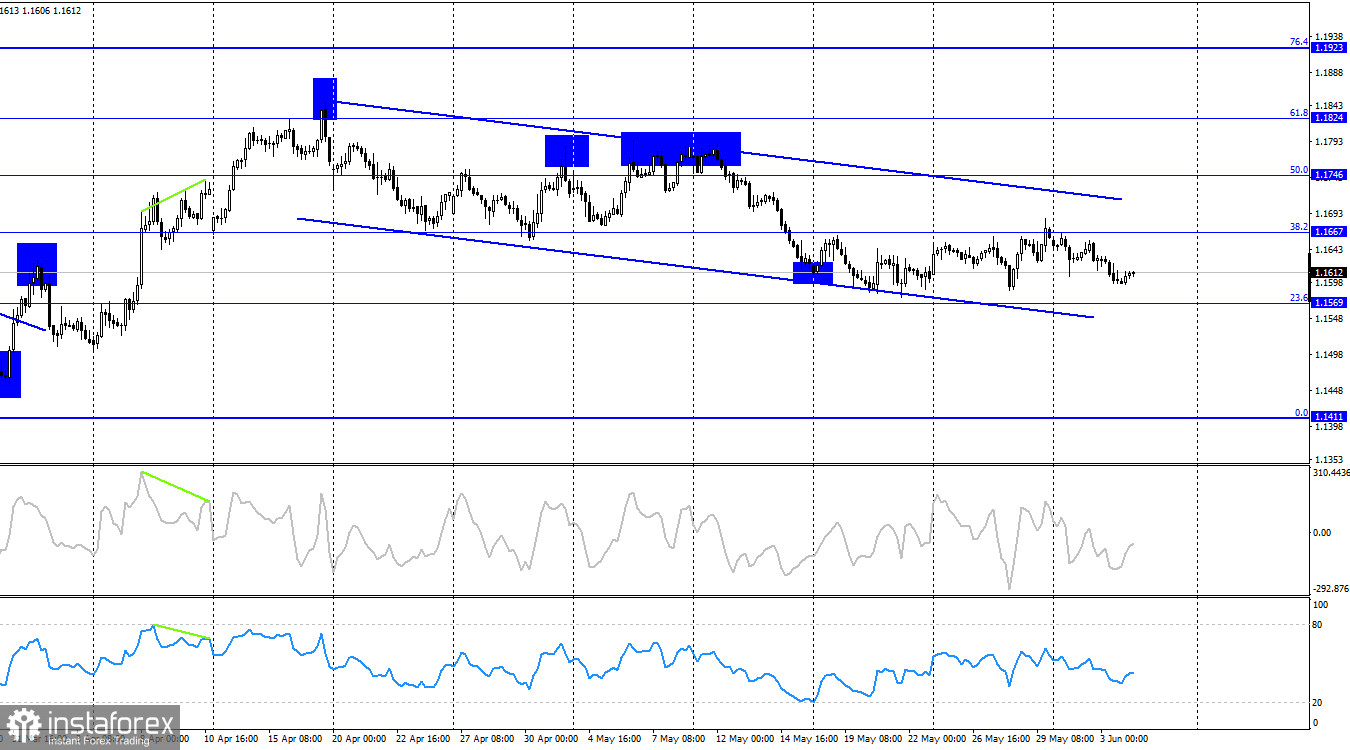
On the 4-hour chart, the pair continues to trade within a horizontal range between the 23.6% Fibonacci retracement level at 1.1569 and the 38.2% level at 1.1667. Market participants remain cautious and are not rushing to establish new positions or draw firm conclusions. Given the relatively subdued price action seen in recent weeks, I recommend focusing primarily on the hourly chart. The rejection from the 1.1667 level favored the U.S. dollar. No emerging divergences are currently visible on any indicators.
Commitments of Traders (COT) Report
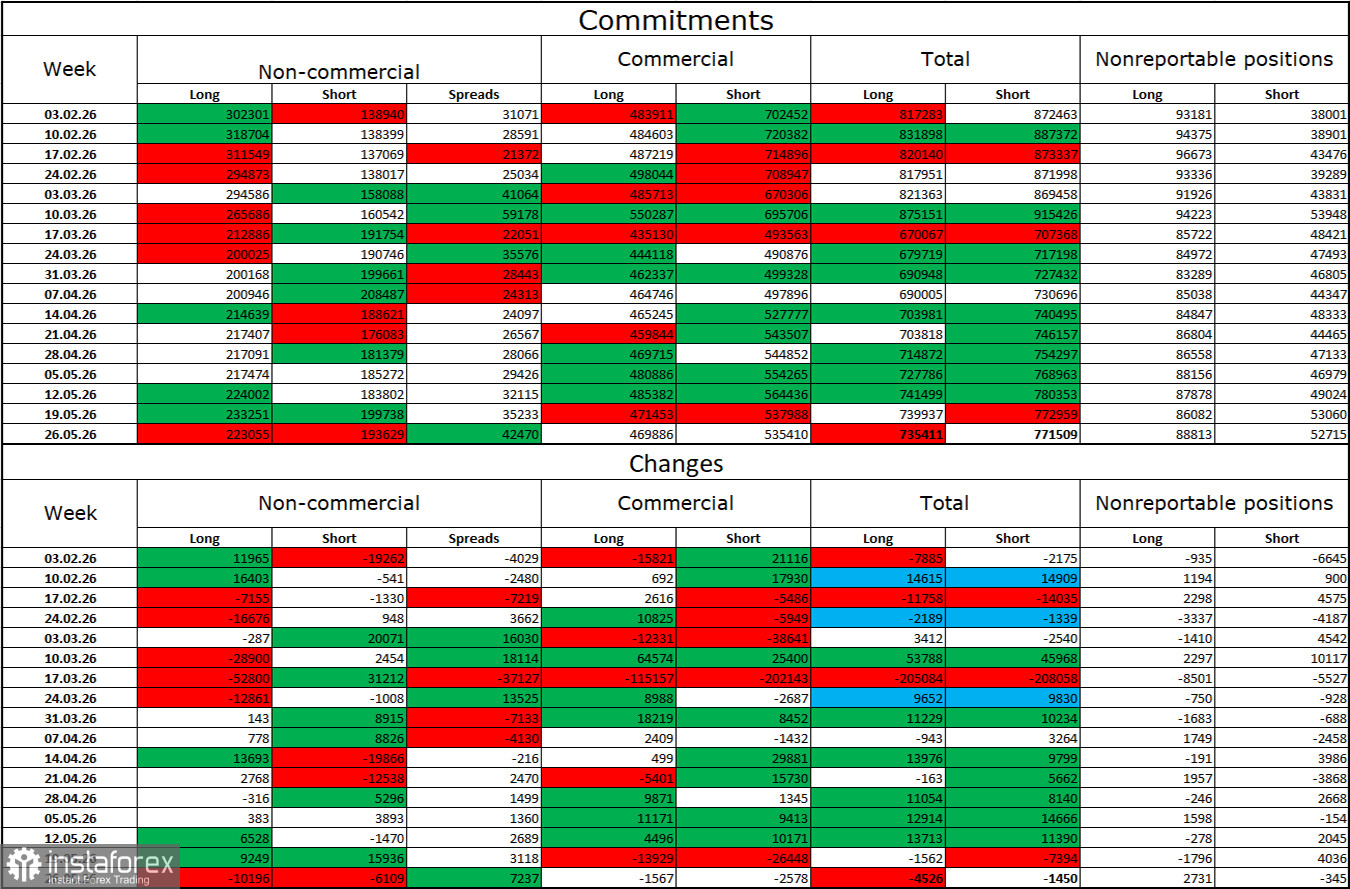
During the latest reporting week, professional traders closed 10,196 long positions and 6,109 short positions. Over seven weeks in February and March, the bulls' overwhelming advantage disappeared due to the conflict involving Iran. Over the past nine weeks, market positioning has become more balanced amid the suspension of hostilities in the Middle East. Speculators currently hold 223,000 long positions and 193,000 short positions. The gap is once again widening in favor of the euro.
From a longer-term perspective, large institutional traders continue to show greater interest in the euro. Naturally, global developments of various kinds—which have been abundant in recent years—continue to influence investor sentiment. At present, the market's primary focus remains on the Middle East, where the conflict has been paused rather than fully resolved. Consequently, the direction of the euro and the U.S. dollar in the near term is likely to depend less on Federal Reserve or ECB monetary policy and economic data, and more on developments in Iran.
Economic Calendar: United States and Eurozone
Eurozone - Speech by ECB President Christine Lagarde (08:00 UTC)
Eurozone - Retail Sales (09:00 UTC)
United States - Initial Jobless Claims (12:30 UTC)
The economic calendar for June 4 contains three scheduled events, none of which are likely to have a significant impact on the market. Therefore, economic data may have little to no influence on market sentiment throughout Thursday's trading session.
EUR/USD Forecast and Trading Recommendations
Short positions were possible following a rebound from the 1.1682 level on the hourly chart, with targets at 1.1630 and 1.1578. The first target has already been reached. New short positions may be considered if the pair retests and rejects the 1.1630 level from below.
Long positions may be considered on a rebound from the 1.1578 level, with targets at 1.1630 and 1.1682.
Fibonacci retracement levels are plotted from 1.1409 to 1.1850 on the hourly chart and from 1.2081 to 1.1411 on the 4-hour chart.