 English
 Русский
 Bahasa Indonesia
 Bahasa Malay
 ไทย
ไทย Español
 Deutsch
 Български
 Français
 Tiếng Việt
 中文
中文 বাংলা
বাংলা हिन्दी
 Čeština
 Українська
 Română


Last Friday, US equity indices collapsed. The S&P 500 fell by 2.64%, and the Nasdaq 100 plunged by 4.81%. The Dow Jones Industrial Average declined by 1.35%.
On Friday, markets were hit by three negative shocks at once. The slump on Wall Street rolled into Asia today: the MSCI Asia Pacific index lost 2.8%, and South Korea's KOSPI plunged by roughly 5%. Samsung fell by 11%, SK Hynix lost 10%, and TSMC slid by 5.7%.
Three factors struck simultaneously. First — Broadcom's disappointment: a weak guide on AI chips triggered broad profit-taking in a sector that had surged 70% in two months. Second — a strong May jobs report: payrolls rose materially above the 85,000 forecast, while the unemployment rate stayed at 4.3%. Upbeat labor data turned into bad news for markets because it strengthens the case for Fed tightening.
Traders are now pricing in roughly a 60% chance of a 25bp hike as early as October and have pushed the odds of a December move higher. Third — Israel struck multiple military targets in Iran in retaliation for rocket attacks, despite President Trump's appeal to Netanyahu to refrain. Brent crude jumped by 3.5% above $96/bbl — the biggest stress test for the April truce since it was agreed.
The 10-year US Treasury yield rose by four basis points to 4.57% — markets are pricing in a tougher Fed. Japan shows a similar pattern, with government yields also rising. Indonesian bonds are in free fall — 10-year yields are up more than 30bp on the week, exacerbating the sell-off in local assets. The dollar strengthened against most G10 currencies.
Notably, by the start of the Asian session, Nasdaq 100 futures had recouped losses and were up about 0.6%, while S&P 500 futures recovered by roughly 0.2%. Bitcoin recouped losses to settle at around $63,000 after Friday's drop below $60,000 — the first such move since Trump's 2024 re-election. The market is clearly looking for a bottom, but there are too many variables. All eyes are now on the Fed meeting on June 16–17 — Kevin Warsh's first as chair, where the market expects the first clear signal on the new chair's policy direction.
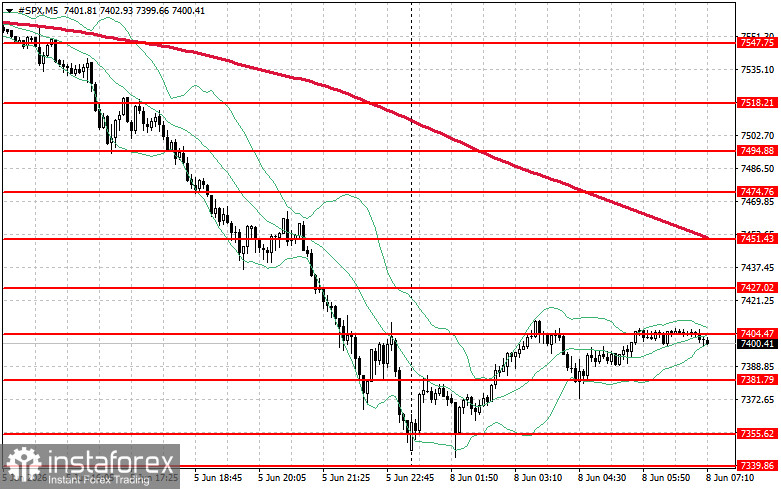
Technically, the S&P 500 analysis suggests that the immediate task for buyers today is to overcome the resistance level of $7,404. Doing so would validate upside and open the path to $7,427. Maintaining control above $7,451 would further strengthen buyers' positions. On the downside, buyers need to defend the $7,381 area. A break below that level would likely push the index back to $7,355 and open the way to $7,339.