 English
 Русский
 Bahasa Indonesia
 Bahasa Malay
 ไทย
ไทย Español
 Deutsch
 Български
 Français
 Tiếng Việt
 中文
中文 বাংলা
বাংলা हिन्दी
 Čeština
 Українська
 Română


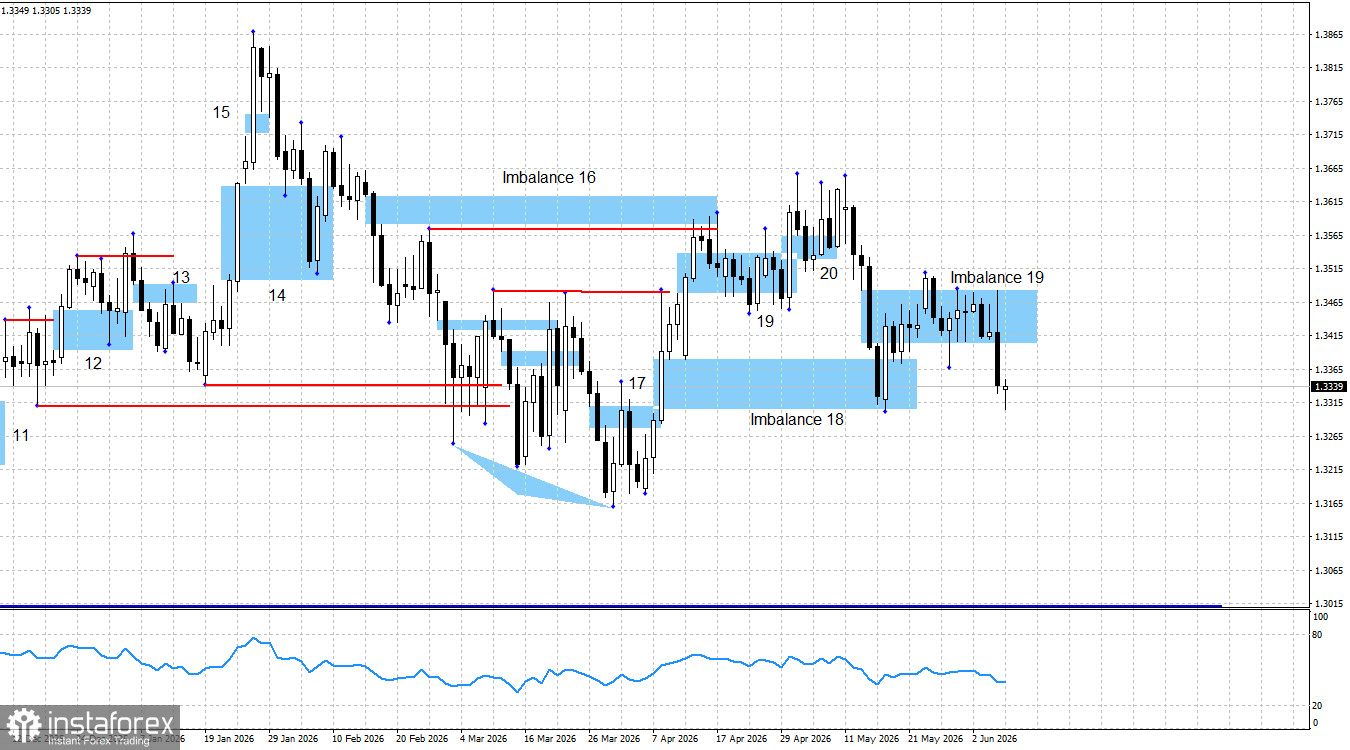
The GBP/USD pair has an excellent opportunity to continue its decline after reacting to Bearish Imbalance 19 following two weeks of trading within it. Undoubtedly, Friday's bearish momentum was fueled by U.S. economic data, which turned out to be unexpectedly strong. I believe few market participants expected such robust Nonfarm Payrolls figures for April and May. However, the U.S. labor market in 2026 is performing considerably better than it did last year, which continues to support the U.S. dollar.
Geopolitical developments are also currently favoring the dollar, as Tehran and Washington remain unable to sign even an interim agreement concerning peace and the reopening of the Strait of Hormuz. As a result, the dollar remains in a more advantageous position compared to the euro and the pound. Although the current chart structure appears fairly straightforward and points toward further downside in the pair, I would caution traders against drawing overly confident conclusions.
On Friday, the dollar received substantial support from the market, but no one knows how events in the Middle East will develop. If an unexpected breakthrough occurs and Donald Trump ultimately reaches an agreement with Iran, demand for the safe-haven dollar could immediately begin to decline. Thus, the bears have received an excellent opportunity to continue their offensive, but sustaining this momentum will require continued geopolitical support. The worse the geopolitical situation becomes, the more favorable it is for the dollar.
Overall, the situation in the Middle East is currently better than it was just a few months ago when the parties were engaged in full-scale military confrontation. However, the balance can shift in the opposite direction at any moment. Over the past several weeks, we have witnessed numerous potential escalations in the Middle East, and only the reluctance of both sides to engage in active military operations has prevented a renewed conflict.
In my view, the broader trend remains bullish despite the pair's sharp declines this year. The ceasefire in the Middle East remains fragile, but it is still in place and could be extended for another 60 days. However, the Strait of Hormuz remains under a dual blockade, the nuclear issue remains unresolved, and any perceived progress in negotiations is based largely on statements from Donald Trump. Iran maintains a completely different position. The situation continues to fluctuate between improvement and deterioration. For now, the market retains some confidence that an agreement can still be reached, but that confidence is not unlimited.
The current chart picture is as follows. Bullish Imbalance 18 generated a reaction from price, but Bearish Imbalance 19 ultimately produced a sell signal as well. Therefore, the technical outlook shifted to bearish in a single day. However, it could reverse again in the coming days, as geopolitical developments have recently been changing several times a day.
The economic calendar provided no meaningful information on Monday. Traders will have to wait another day or two before new economic data begins to arrive. There is certainly no shortage of geopolitical headlines, but the market is currently unwilling to react to secondary news. Today, reports emerged of Iranian strikes against Israel, yet GBP/USD is rising, which means the dollar is weakening.
The broader fundamental backdrop remains such that, from a long-term perspective, I continue to expect further weakness in the U.S. dollar. Even the conflict between Iran and the United States changes little in this regard. Geopolitical tensions have temporarily reminded investors of the dollar's safe-haven status over the past two months, but the overall environment for the U.S. currency remains less than favorable.
If the U.S. economy gains additional momentum in 2026, the Federal Reserve resumes its monetary tightening cycle, and the conflict between the United States and Iran evolves into a prolonged confrontation, then the dollar could indeed target the 1.3100–1.3000 level. However, in my opinion, the long-term outlook for the U.S. dollar cannot change solely because of one strong Nonfarm Payrolls report.
News Calendar for the United States and the United Kingdom:
- United States – Existing Home Sales (14:00 UTC).
The economic calendar for June 9 contains only one event, which is unlikely to attract significant market attention. Therefore, the impact of the economic backdrop on market sentiment on Tuesday is expected to be minimal.
GBP/USD Forecast and Trading Recommendations:
For the British pound, the long-term outlook remains bullish; however, the most recent signal generated is a sell signal. Therefore, in the near term, provided that geopolitical developments do not interfere, bears may continue their attack toward the lows of May 18 and March 31. Liquidity could be taken from those swing lows, after which, if geopolitical conditions become more favorable, bulls may once again take control.
At present, it is difficult to imagine that the conflict between Iran and the United States will be resolved in the near future. Therefore, the pound's upward potential remains relatively limited.