 English
 Русский
 Bahasa Indonesia
 Bahasa Malay
 ไทย
ไทย Español
 Deutsch
 Български
 Français
 Tiếng Việt
 中文
中文 বাংলা
বাংলা हिन्दी
 Čeština
 Українська
 Română


US equity indexes closed lower again yesterday. The S&P 500 fell 0.69%, the Nasdaq 100 dropped 1.33%, and the Dow Jones Industrial Average lost 0.22%.
The sell-off in chipmakers intensified amid higher bond yields and geopolitical uncertainty. Samsung Electronics and SK Hynix shares plunged by more than 7% in Seoul after US chipmakers' losses dragged the Philadelphia semiconductor index down about 5%—its worst session since late July. The broader MSCI Asia-Pacific equity index lost 2.2%. South Korea's KOSPI led regional declines, plunging about 5.6%.
Pressure on sentiment was compounded by rising oil. Brent climbed for a fourth consecutive day, trading above $91.60 per barrel after a 4.5% rise over the prior three sessions, as fighting flared again in Lebanon and President Trump said he is not interested in extending an expiring deal with Iran.
As noted above, the principal cause of the technology sell-off lies in the debt market. Technology stocks, typically a bet on long-term growth, came under renewed pressure as bond yields hover near 10-year highs amid persistent inflation and large government spending. Ongoing turbulence in the Middle East raises the risk of energy supply shocks that could keep inflation and borrowing costs elevated for longer.
The bond market itself showed signs of stabilization after the earlier wash-out: Treasuries rallied moderately following moves that pushed the 10-year yield to 2025 highs and the 30-year yield to levels not seen since 2007.
Geopolitical risk continued to worsen. Tensions in the Middle East rose after the UAE said two ballistic missiles fired from Iran toward the country fell into the sea—the first reported Iranian strike on the Gulf state since May amid the protracted conflict. In other markets, the Canadian dollar strengthened after the Trump administration agreed to delay, by three days, the imposition of 50% tariffs on billions of dollars of Canadian imports following tense talks in Washington.
Today's main event is the release of the minutes from the last Fed meeting, which may offer clues on policymakers' thinking at a time when Chair Kevin Warsh has substantially scaled back communications with the market.
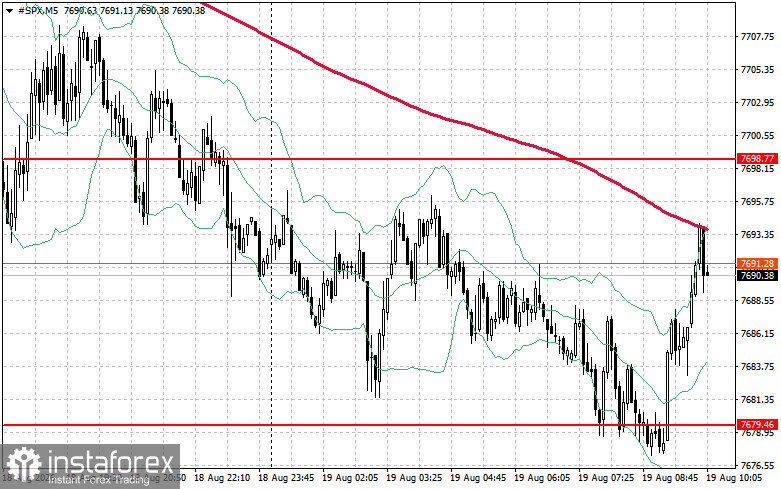
According to the technical picture for the S&P 500, buyers' immediate task today is to clear resistance at $7,698. That will show strength and open the way to $7,718. Controlling $7,737 would further cement the bulls' position. On the downside, if risk appetite ebbs, buyers must defend $7,679. A break there will quickly push the index back to $7,656 and open the road to $7,633.