 English
 Русский
 Bahasa Indonesia
 Bahasa Malay
 ไทย
ไทย Español
 Deutsch
 Български
 Français
 Tiếng Việt
 中文
中文 বাংলা
বাংলা हिन्दी
 Čeština
 Українська
 Română


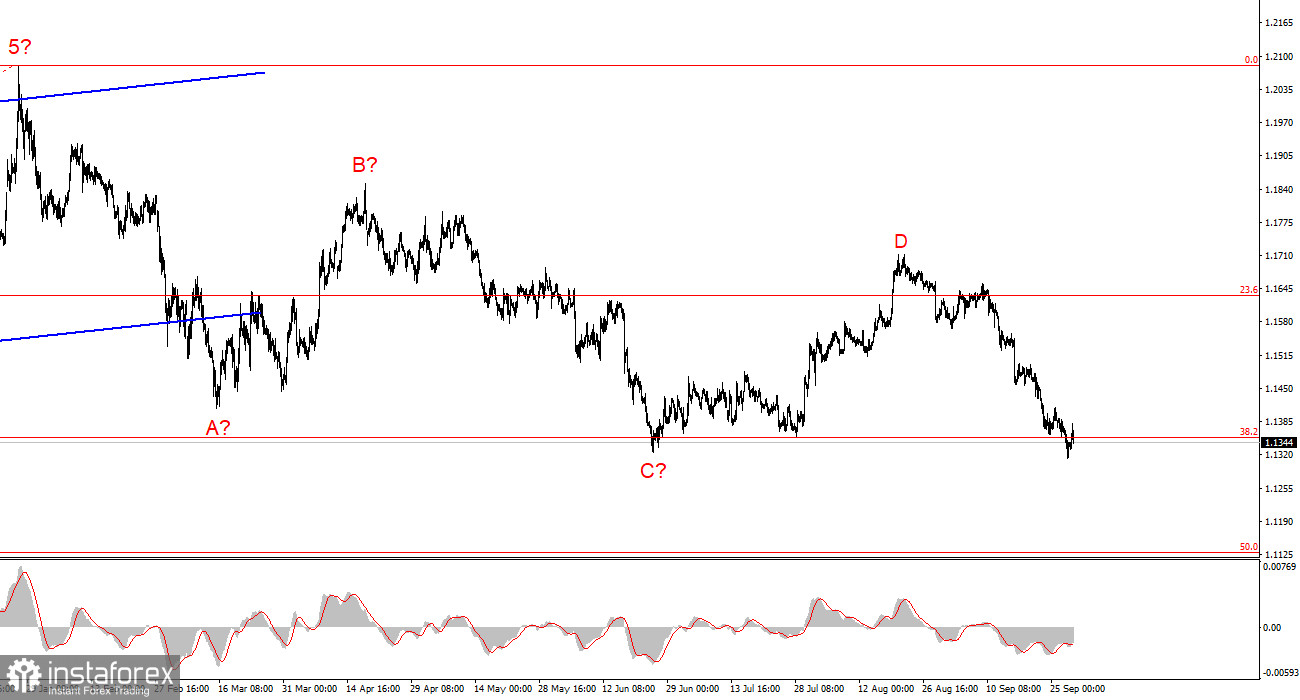
The wave structure of the EUR/USD 4-hour chart is becoming more complex. There is still no question of canceling the upward trend segment (lower chart), which began in January last year. On the contrary, we have seen a full corrective A-B-C structure, which may have been completed. However, recent developments related to the Fed and its policy have once again affected the current wave structure, making it more complex. I would remind you that the news background and wave structure often conflict with each other, making adjustments necessary.
The wave structure has now transformed into a more complex formation. Wave C has taken a three-wave form, while the next wave is identified as wave D. The entire trend segment that began on January 27 may have taken the form of a five-wave corrective structure A-B-C-D-E. If this assumption is correct, wave D is complete, and on August 21, the EUR/USD pair entered the phase of forming wave E, whose low should be below the low of wave C at 1.1325. The pair is now very close to this level, and below it, the assumed wave E may complete its formation at any time.
The dollar's decline was short-lived, followed by another rise.
The EUR/USD pair remained virtually unchanged on Wednesday, while the range of movements was once again very narrow. Despite the release of several important reports today, which showed very interesting figures, the market once again found no reason to buy the euro, no reason for more active movements, and no reason to sell the dollar. The day began optimistically for the European currency. The euro gained around 40 points, and some market participants had already begun to expect at least a local corrective wave. However, the recovery was short-lived. In the second half of the day, the market began to decline again. It cannot be said that this move was unjustified.
I have repeatedly said that the latest rise in the US dollar, which has already lasted for three weeks, looks questionable, to say the least. I understand that the market now expects another 2–3 rounds of monetary policy tightening from the Fed, although it is difficult to say exactly what the market expects. For example, according to the CME FedWatch tool, the probability of an interest rate hike in October fell to 41% today, compared with 70–75% yesterday. The reason is that Fed official John Williams said yesterday that the regulator has no need to rush into the next round of policy tightening. Today, the core Personal Consumption Expenditures price index came in at 3.4%, instead of the 3.7% expected by the market. Therefore, inflation in the United States is not accelerating, and some FOMC participants see no reason for tightening in October. However, even this information was unable to reduce demand for the dollar. In the second half of the day, the US currency was once again in demand. This was probably because US GDP came in at a solid 2.2% in the second quarter.
General Conclusions
Based on my analysis of EUR/USD, I conclude that the pair remains within a global corrective trend segment A-B-C-D-E. If this assumption is correct, the decline in the exchange rate will continue, with targets located below the low of wave C at 1.1325. I considered this scenario to be an alternative one, and if not for the Fed meeting, it would have remained a secondary scenario. However, the Fed delivered a surprise, and the market was left with no other option than a new wave of US dollar buying. At the same time, buying has continued for several weeks, although the dollar has no new supporting factors. I would not open short positions against this news background and would instead prepare for a reversal.
On the higher timeframe, a downward trend segment can be seen, taking the form of A-B-C-D-E. Therefore, the EUR/USD pair may continue to decline below the low of wave C, while the internal wave structure of wave E may take a five-wave impulsive form.
Main Principles of My Analysis
- Wave structures should be simple and clear. Complex structures are difficult to trade and often involve changes.
- If there is no confidence in what is happening in the market, it is better not to enter the market.
- There can never be 100% certainty about the direction of a price movement. Do not forget to use protective Stop Loss orders.
- Wave analysis can be combined with other types of analysis and trading strategies.