 English
 Русский
 Bahasa Indonesia
 Bahasa Malay
 ไทย
ไทย Español
 Deutsch
 Български
 Français
 Tiếng Việt
 中文
中文 বাংলা
বাংলা हिन्दी
 Čeština
 Українська
 Română


Trade analysis and tips for the British pound
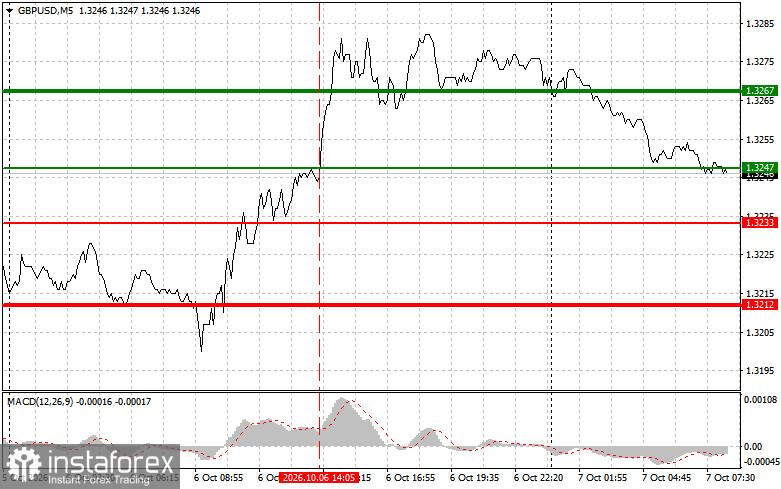
The test of 1.3247 occurred when the MACD indicator moved well above the zero line, limiting the pair's upside potential.
The pound rose yesterday on weak US data, but this morning brought a correction. In the Asian session, demand for the dollar returned, and the British currency no longer looks as confident as it did yesterday. US external-trade data drove yesterday's dollar weakness for August: the goods and services deficit jumped to $105.6bn, the largest since early 2025; imports rose 4.3% to a record while exports rose only 1.4%.
Today the pound must live without its own news, and that is the day's main feature. The only first-half release is Lloyds' house-price index for September, and expectations are modest (+0.2% vs -0.2% the month before). Note that the prior figure has already been revised: August's decline was adjusted to -0.4%, so the market starts from a lower base than previously thought. Other indicators paint a slightly different picture: Nationwide showed annual house-price growth of 1.6%, so demand for housing hasn't disappeared, but builders and buyers are cautious because borrowing costs are high. For the pound, the lack of local catalysts means dependence on external forces. I expect GBP/USD to trade in a narrow range in the first half of the day because traders have little to do until the US picture clears up.
For intraday strategy, I will rely mainly on Scenario 1 and Scenario 2.
Scenarios to buy
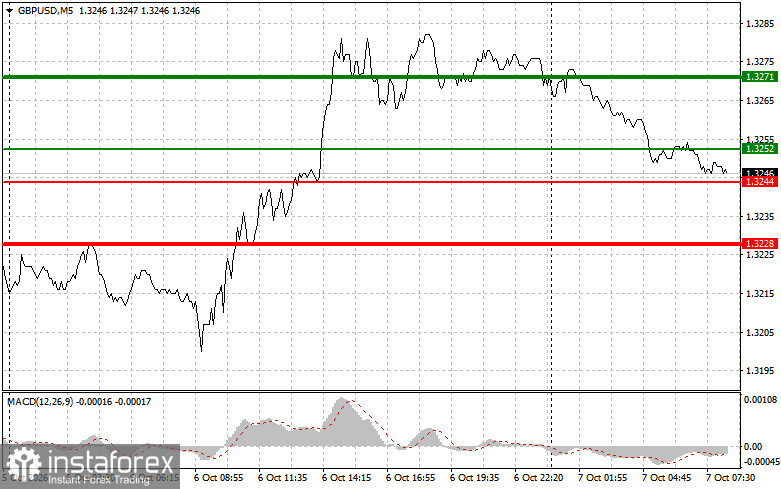
Scenario 1: Buy the pound today if price reaches the entry area around 1.3252 (green line) with a target of 1.3271 (thicker green line). Around 1.3271, plan to exit long positions and open short positions for a counter-move (expecting 30–35 pips). Expect pound strength only after good data. Important: before buying, ensure MACD is above zero and only beginning its rise.
Scenario 2: Also buy if there are two consecutive tests of 1.3244 while MACD is in the oversold area. This would limit downside potential and trigger an upward reversal. Expect moves toward 1.3252 and 1.3271.
Scenarios to sell
Scenario 1: Sell the pound after the 1.3244 level is breached (red line); this should lead to a rapid decline. The sellers' key target is 1.3228, where I plan to exit shorts and immediately open longs for a counter-move (expecting 20–25 pips). Bad news will put pressure back on the pound. Important: before selling, ensure MACD is below zero and only beginning its decline.
Scenario 2: Also sell if there are two consecutive tests of 1.3252 while MACD is in the overbought area. This would cap upside and trigger a downward reversal. Expect declines to 1.3244 and 1.3228.
What's on the chart:
Thin green line – entry price at which you can buy the trading instrument.
Thick green line – approximate price where you can place Take Profit or manually lock in profits, since further upside above this level is unlikely.
Thin red line – entry price at which you can sell the trading instrument.
Thick red line – approximate price where you can place Take Profit or manually lock in profits, since further downside below this level is unlikely.
MACD indicator. When entering the market, it is important to follow the overbought and oversold zones.
Important. Beginner traders in the Forex market must be very cautious when making entry decisions. It is best to stay out of the market before the release of important fundamental reports to avoid getting caught in sharp price swings. If you decide to trade during news releases, always place stop orders to minimize losses. Without stop orders,, you can quickly lose your entire deposit, especially if you don't use money management and trade large volumes.
Remember that successful trading requires a clear trading plan, like the example above. Spontaneous trading decisions based on the current market situation are inherently a losing strategy for an intraday trader.