 English
 Русский
 Bahasa Indonesia
 Bahasa Malay
 ไทย
ไทย Español
 Deutsch
 Български
 Français
 Tiếng Việt
 中文
中文 বাংলা
বাংলা हिन्दी
 Čeština
 Українська
 Română


Trade Analysis and Trading Advice for the Japanese Yen
The price test at 158.35 occurred when the MACD indicator was just beginning to move upward from the zero line, confirming that it was the right time to enter a long position on the US dollar. As a result, the pair rose by 15 points.
The yen is approaching the US inflation release with a degree of resilience provided by developments over the past few days. Most recently, Bank of Japan Governor Kazuo Ueda stated that rate hikes would continue, while their pace and timing remained open questions. This helped limit pressure on the yen. The current interest rate stands at 1.25%, and the market assigns approximately a 25% probability to a rate hike at the October 30 meeting.
However, everything will depend on the United States in the second half of the day. The Consumer Price Index will show how quickly the cost of the US consumer basket is rising. Inflation is expected to increase by 0.6% month over month and 3.7% year over year. This is a key figure for USD/JPY because it affects US bond yields and, consequently, the attractiveness of the dollar relative to the yen. As a reminder, the yield on 10-year US Treasury securities approached 5.31% last week, while the yield on 10-year Japanese government bonds stood at 3.025%. The gap remains wide, and any surprise in US inflation could quickly change this picture. If the figure comes in significantly above expectations, the dollar will receive support. Speeches by Federal Reserve officials Michelle Bowman and Thomas Barkin will provide additional context.
As for the intraday strategy, greater emphasis will be placed on the implementation of Scenarios No. 1 and No. 2.
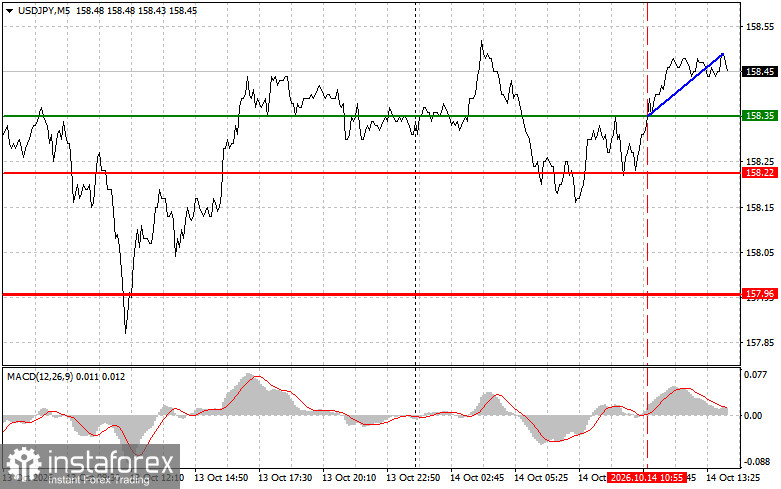
Buy Signal
Scenario No. 1: Today, I plan to buy USD/JPY when the price reaches the entry point around 158.53 (the green line on the chart), targeting a rise to 158.82 (the thicker green line on the chart). Around 158.825, I will close long positions and open short positions in the opposite direction, targeting a move of 30–35 points in the opposite direction from that level. The pair could rise today, but the upward potential is relatively limited. Important! Before buying, make sure that the MACD indicator is above the zero line and is just beginning to rise from it.
Scenario No. 2: I also plan to buy USD/JPY today if the price tests 158.37 twice consecutively while the MACD indicator is in the oversold zone. This would limit the pair's downward potential and trigger a reversal to the upside. The pair could rise toward the opposite levels of 158.53 and 158.82.
Sell Signal
Scenario No. 1: Today, I plan to sell USD/JPY after the price breaks below 158.37 (the red line on the chart), which would lead to a rapid decline in the pair. The sellers' key target will be 157.96, where I will close short positions and immediately open long positions in the opposite direction, targeting a move of 20–25 points in the opposite direction from that level. Downward pressure on the pair could return today if the central bank intervenes. Important! Before selling, make sure that the MACD indicator is below the zero line and is just beginning to decline from it.
Scenario No. 2: I also plan to sell USD/JPY today if the price tests 158.53 twice consecutively while the MACD indicator is in the overbought zone. This would limit the pair's upward potential and trigger a reversal to the downside. The pair could decline toward the opposite levels of 158.37 and 157.96.
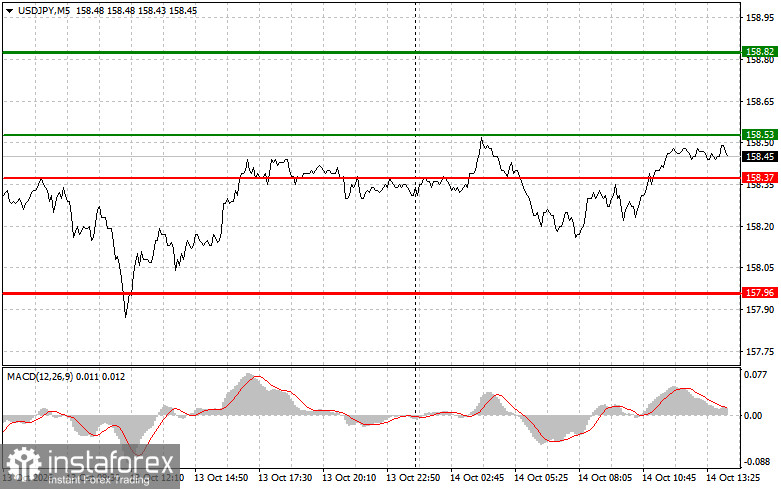
What the Chart Shows
- Thin green line – the entry price at which the trading instrument can be bought.
- Thick green line – the projected price at which Take Profit orders can be placed or profits can be taken manually, as further upside beyond this level is unlikely.
- Thin red line – the entry price at which the trading instrument can be sold.
- Thick red line – the projected price at which Take Profit orders can be placed or profits can be taken manually, as further downside beyond this level is unlikely.
- MACD indicator. When entering the market, it is important to consider the overbought and oversold zones.
Important. Beginner Forex traders should make market-entry decisions with great caution. Before the release of major fundamental reports, it is generally best to stay out of the market to avoid sharp exchange-rate fluctuations. If you decide to trade during news releases, always place stop-loss orders to minimize losses. Without stop-loss orders, you can lose your entire account balance very quickly, especially if you do not use money management and trade large volumes.
Remember that successful trading requires a clear trading plan, such as the one presented above. Making spontaneous trading decisions based on current market conditions is, from the outset, a losing strategy for an intraday trader.