 English
 Русский
 Bahasa Indonesia
 Bahasa Malay
 ไทย
ไทย Español
 Deutsch
 Български
 Français
 Tiếng Việt
 中文
中文 বাংলা
বাংলা हिन्दी
 Čeština
 Українська
 Română


Yesterday's US data was strong, yet the dollar only received a brief lift. The currency spiked after the releases but lacked the follow-through to extend gains against the euro, the pound, and the yen. The market had already priced in Fed tightening after Wednesday, when the US dollar index hit a high since May 2025, so another inflation surprise wasn't enough to ignite a new leg higher.

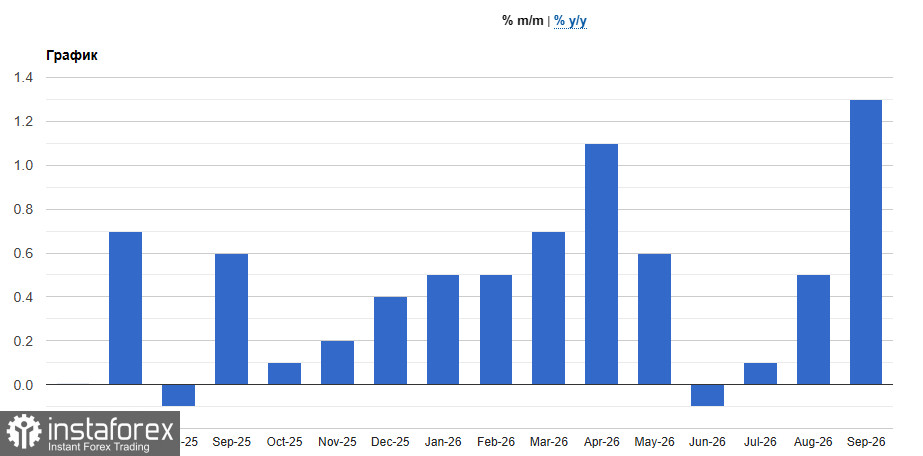
Producer prices were the main shock. The PPI rose by 1.3% in September versus a 0.5% forecast and a 0.5% gain in August (0.2% in July). It was the largest monthly jump since March 2022 (then +1.7%). On a year-over-year basis, producer price inflation accelerated to 6.3% from 5.6% a month earlier (consensus 5.3%), marking the highest reading since December 2022 (6.4%).
Where the pressure came from is revealing. Goods prices jumped by 2.6%, the largest monthly rise since the series began in December 2009. Energy accounted for more than 80% of that move, climbing by 10.8%, with gasoline up 20.3%. Food rose by 1.2%, while core goods (ex-food & energy) were up just 0.3%. Services gained 0.8%, the strongest monthly increase since April, with trade margins contributing about half of that (up 1.4%) and transport & warehousing costs rising by 3.4%.
Core measures were also hot. PPI ex-food & energy rose by 0.7% (consensus 0.3%, 0.2% in August), and on a year-over-year basis, it accelerated to 5.0% from 4.8% (consensus 4.4%). The measure, excluding food, energy, and trade services, added 0.5% after 0.3% in August. The losers here are companies unable to pass higher input costs to customers; winners are those with pricing power that have already raised margins.
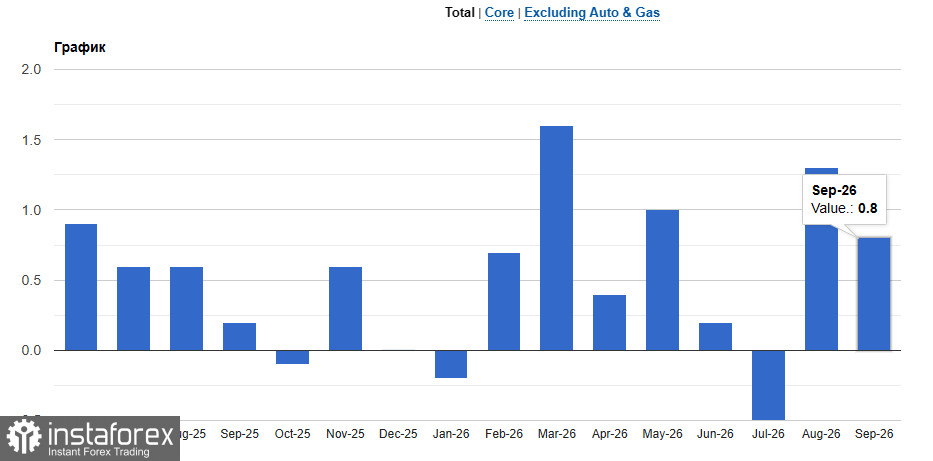
Retail sales confirmed resilient demand. Headline retail receipts rose by 0.8% in September (consensus 0.3%), though August was revised up to 1.3%. Industrial surveys painted a mixed picture: the Philly Fed index fell to 20.9 (consensus 26.5, 37.8 prior), while the Empire Manufacturing index jumped to 25.5 (consensus 10.3, 7.6 prior). The labor market remains firm: initial jobless claims were 199k (consensus 200k, 198k prior), while continuing claims matched expectations at 1,710k (vs. 1,714k). Commercial inventory levels added 0.4% in August as expected, after +0.9% the month before.
What this means for the Fed is straightforward. Producer inflation typically feeds through to consumer prices with a lag, so PPI strength implies continued CPI pressure in the coming months. Combined with the hotter-than-expected core CPI, the data undercut John Williams's suggestion that a single hike this year might suffice. In my view, a December rate increase now looks highly likely, and hawkish votes from officials such as Beth Hammack and Ostan Gulsby carry more weight. The October 27–28 meeting will probably be a pause, but guidance toward December should be firm.
So why didn't the dollar rally further? Because the market had already priced in a hawkish Fed, and bond markets were dominated by safe-haven demand that pushed yields down amid AI-related equity selling. At the same time, the euro, the pound, and the yen had their own supports — notably strong UK GDP for the pound. The dollar's failure to run on such tough numbers is itself a signal: it suggests that market expectations for further near-term Fed tightening are mostly exhausted.
My outlook: unless new evidence emerges that the Fed will be more aggressive than currently priced, the dollar's upside will be limited, and rallies will attract sellers. If yields continue to decline due to demand for Treasuries, I expect some pullback in the dollar against the euro, the British pound, and the yen. If inflation keeps surprising to the upside and the Fed reaffirms further hikes, the dollar will reclaim the initiative.
EUR/USD technicals
Buyers need to reclaim 1.1241 to target a test of 1.1275. From there, a push to 1.1310 is possible, but doing so without support from large players will be difficult. On the downside, I expect sizable buyer interest around 1.1193. In case of subdued buying activity in this area, wait for a decline to the 1.1156 low or consider long positions from 1.1117.
GBP/USD technicals
Sterling buyers should reclaim near the resistance level of 1.3310 to target 1.3340. A break above that mark would open a path to 1.3370. On the downside, bears will try to take control at 1.3275. A break below that level would hit bulls and could push GBP/USD toward 1.3230 and then 1.3200.