 English

 Русский
 Bahasa Indonesia
 Bahasa Malay
 ไทย
 Español
 Deutsch
 Български
 Français
 Tiếng Việt
 中文
 বাংলা
 हिन्दी
 Čeština
 Українська
 Română



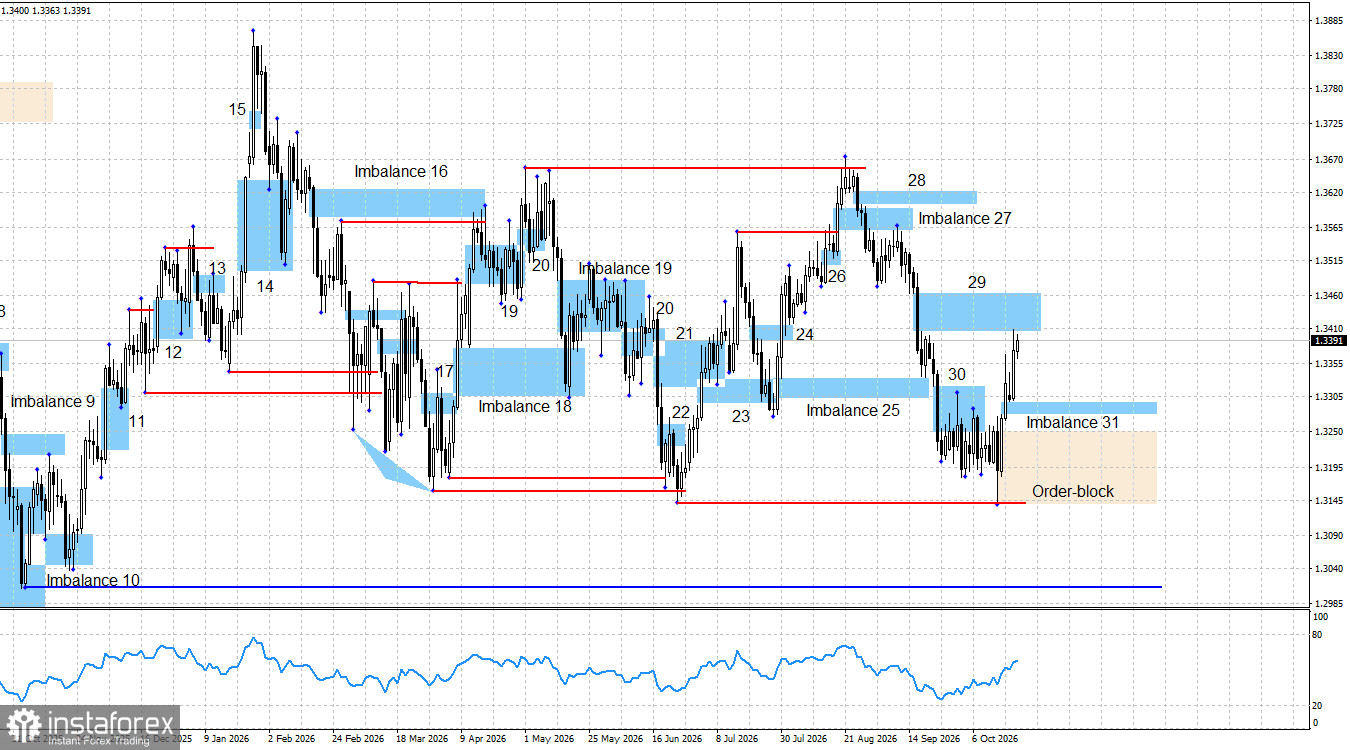
The GBP/USD pair began rising after sweeping liquidity below the latest bearish swing and has since gained 260 points. Over the past four days, the pound has risen steadily, invalidating Imbalance 30, which had failed to produce a convincing reaction. This is the first step toward forming a bullish trend. In addition, bearish Imbalance 29 produced virtually no reaction, although a response remains possible if the price moves deeper into the zone. A bullish order block and bullish Imbalance 31 have also formed. In other words, liquidity below the lows was swept, two bullish patterns emerged, one bearish pattern was invalidated, and the other may be ignored. In my view, the chart structure is shifting rapidly in favor of the bulls. The pound's advance has been so strong that the price has not yet been able to revisit either bullish pattern, which would require a corrective pullback.
As for the fundamental backdrop supporting the pound, conditions have become considerably more favorable this week. Unemployment has declined, inflation has risen, and the Bank of England can no longer afford to wait. The market has not yet priced in any Bank of England rate hikes, unlike the Federal Reserve's policy tightening, which has already been more than fully priced in. I see little that could prevent the bulls from continuing their advance.
It is worth noting that traders expect two or three rounds of monetary policy tightening from the Bank of England, compared with just one or, at most, two from the Federal Reserve. The dot plot also points to one rate hike, while the latest FOMC minutes confirmed that most policymakers expect only one 0.25-percentage-point increase. Of course, the outlook for 2027 remains uncertain, but that is the current consensus forecast. Consequently, the Bank of England could ultimately raise interest rates more aggressively than the Fed in the coming months, which would clearly not support further US dollar appreciation.
Had the Fed not raised interest rates in September and signaled its willingness to continue tightening monetary policy, a decline in the US dollar would have been expected a month ago. That remains the expectation now. GBP/USD has reversed in favor of the pound, and the next step is to form new bullish patterns that traders can use as entry points for long positions. In my view, the pound's long-term outlook remains bullish.
Do the bears have any further upside potential for the dollar? In my view, very little. Over the past month and a half to two months, the bears appear to have achieved the seemingly impossible by pushing the dollar to its highest levels in recent times. The market has had reasons to buy the dollar, but there have also been reasons for the pound to appreciate that traders have simply overlooked. A reversal may now begin, and this move could be more consistent with the underlying fundamentals than the preceding decline.
The economic backdrop on Wednesday once again supported the bulls. UK consumer price inflation rose above expectations in September, as did core inflation. The Bank of England can therefore move ahead with monetary policy tightening, and several rounds of rate increases may be necessary before inflation, which is approaching 4% at a rapid pace, begins to slow.
Overall, the fundamental backdrop remains such that a long-term decline in the US dollar appears to be the most likely outcome. The war between Iran and the United States has not changed this outlook. Geopolitical tensions reminded the market of the dollar's safe-haven status for several months, but the conflict has already passed its most acute phase. The FOMC's future policy path remains uncertain, while the market continues to anticipate further tightening, which is the main reason for the bears' optimism. However, traders continue to overlook the prospect of monetary policy tightening by the Bank of England, as reflected in several recent speeches by Monetary Policy Committee (MPC) members. Inflation in the UK is rising, as it is around the world, leaving the Bank of England with little choice but to raise interest rates as well.
Economic Calendar for the United States and the United Kingdom
- United Kingdom – Speech by Bank of England Governor Andrew Bailey (10:50 UTC).
- United States – Initial Jobless Claims (12:30 UTC).
On October 22, the economic calendar contains two events, with Andrew Bailey's speech being particularly noteworthy. Economic developments could influence market sentiment on Thursday.
GBP/USD Forecast and Trading Recommendations
The long-term outlook for the pound remains bullish. The bears controlled the market in recent weeks, but the broader trading range is clearly visible on the daily chart. The liquidity sweep below the swing low formed on May 1 triggered a decline within the horizontal range. However, liquidity was also swept below the June lows, allowing the bulls to regain control.
Therefore, the local market structure has also turned bullish. For traders, this means that the preferred approach in the near term is either to maintain existing long positions or to look for new buying opportunities. Potential entry zones include the order block and Imbalance 31. However, a corrective pullback will be needed for the price to revisit these zones. The pound's target is near the upper boundary of the trading range at 1.3670. A reaction to Imbalance 29 could trigger the corrective pullback needed for this move.