 English

 Русский
 Bahasa Indonesia
 Bahasa Malay
 ไทย
 Español
 Deutsch
 Български
 Français
 Tiếng Việt
 中文
 বাংলা
 हिन्दी
 Čeština
 Українська
 Română



Trade analysis and tips for trading the Japanese yen
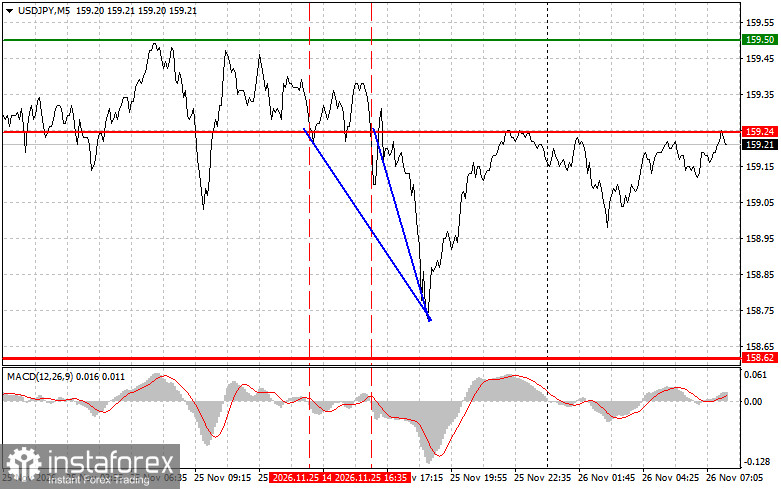
The price test at 159.24 occurred as the MACD indicator was beginning to move down from the zero line, confirming a good entry point to sell the dollar. As a result, the pair fell about 50 pips.
The main driver for USD/JPY yesterday was U.S. data, and it was strong on most points, yet the yen ignored it. The report showed the U.S. economy grew at an annualized 4.3% pace in Q3, and the first estimate was revised markedly upward, mainly due to business investment and consumption. The core Personal Consumption Expenditures index accelerated to 3.3% year-on-year and the headline to 3.8%, meaning inflation in the country is not retreating but gaining pace. This is a strong argument that the Federal Reserve will have to continue tightening. But there were nuances. Durable goods orders rose just 0.2%, the core component added 0.5%, and personal spending increased 0.3% — and adjusted for prices, real spending even slightly fell. Personal incomes rose 0.7%, and the savings rate was 4.1%.
Normally such a bundle of data would have pushed the dollar up and USD/JPY higher, but that did not happen. The yen remained stable and held below the 160 mark, which the market treats as a psychological barrier and is wary of testing. Domestic data also support it. Yesterday Japan released corporate services price data, which rose 4.2% year-on-year, and the Bank of Japan's core CPI was 2.3%. Former BOJ board member Makoto Sakurai said the rate could rise to 2% by mid-next year and considers the December 18 hike a done deal; the market prices its probability at roughly 80%.
I believe that while BOJ tightening expectations remain firm, even strong U.S. data will not push USD/JPY above 160, and the yen will continue to hold in the current range.
For intraday strategy, I will rely more on executing scenarios No. 1 and No. 2.
Scenarios for Buying
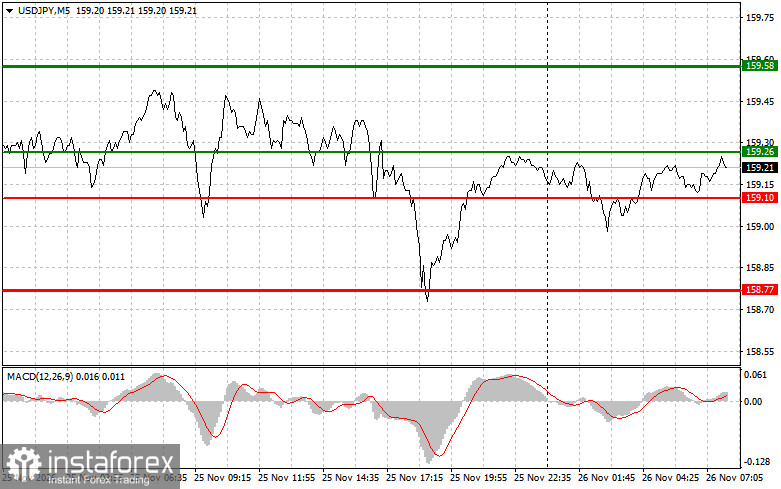
Scenario No. 1: I plan to buy USD/JPY today when the entry point reaches around 159.26 (the green line on the chart), targeting a rise to 159.58 (the thicker green line on the chart). Around 159.58, I intend to exit long positions and open short positions in the opposite direction (expecting a 30–35 pip move back from that level). It is best to return to buying the pair on corrections and significant drawdowns in USD/JPY. Important! Before buying, make sure the MACD indicator is above the zero line and is just beginning to rise from it.
Scenario No. 2: I also plan to buy USD/JPY today in the event of two consecutive tests of 159.10 when the MACD indicator is in the oversold area. This will limit the pair's downside potential and lead to an upward reversal. You can expect a rise to the opposite levels 159.26 and 159.58.
Scenarios for Selling
Scenario No. 1: I plan to sell USD/JPY today only after the 159.10 level is retested (the red line on the chart), which should lead to a rapid decline in the pair. The sellers' key target will be 158.77, where I intend to exit shorts and immediately open longs in the opposite direction (expecting a 20–25 pip move back from that level). Sellers can return at any moment — only a hint from the central bank is needed. Important! Before selling, make sure the MACD indicator is below the zero line and is just beginning to fall from it.
Scenario No. 2: I also plan to sell USD/JPY today in the event of two consecutive tests of 159.26 when the MACD indicator is in the overbought area. This will limit the pair's upside potential and lead to a downward reversal. You can expect a decline to the opposite levels of 159.10 and 158.77.
What's on the Chart:
Thin green line – the entry price at which you can buy the trading instrument;
Thick green line – the suggested price where you can place a Take Profit or manually lock in gains, since further upside above this level is unlikely;
Thin red line – the entry price at which you can sell the trading instrument;
Thick red line – the suggested price where you can place a Take Profit or manually lock in gains, since further downside below this level is unlikely;
MACD indicator. When entering the market, it is important to follow the overbought and oversold zones.
Important. Beginner Forex traders must be very cautious when making entry decisions. Before the release of important fundamental reports, it is best to stay out of the market to avoid getting caught in sharp price swings. If you decide to trade during news releases, always place stop orders to minimize losses. Without stop orders, you can quickly lose your entire deposit, especially if you don't use money management and trade large volumes.
Remember, successful trading requires a clear trading plan, like the example I presented above. Spontaneous trading decisions based on the current market situation are a losing strategy for an intraday trader from the start.